


With Labor Day behind us, it’s time to focus on midterms. The outcome will play a significant role in shaping the nation’s future for several years to come.
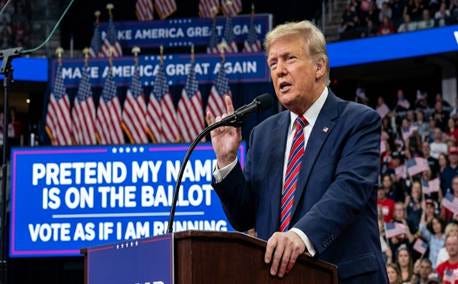
When Donald Trump declares ‘Pretend I’m on the Ballot,’ he effectively turns every race into a Trump referendum with his name stamped on every ballot line. In fact, maybe that’s what Democrats want voters to “pretend.” Midterm elections are often considered a referendum on the sitting president – with few exceptions.
As Trump suffers from near historic low approval ratings – in the low ‘30s -- he has cast a long shadow over the midterms, drowning out GOP candidates actually on the ticket. He’s the face of the ticket, dragging the party down.
Democrats once feared that Trump’s ad machine and $400 million MAGA SuperPAC war chest would bury them in non-stop ads and campaign rallies. But as his campaign ads and “all about me” strategy finally surfaced, Democrats are now “cheering.”
Trump’s Midterm Fantasy
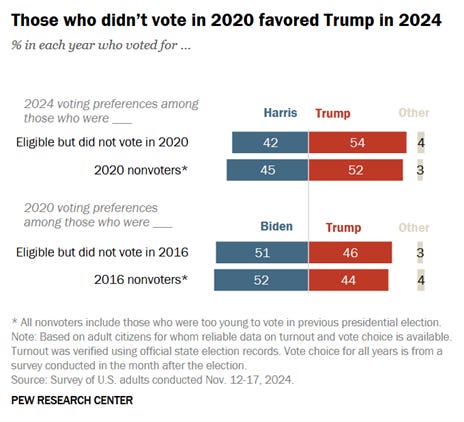
Trump’s view stems from his misguided belief that he can replicate his 2024 winning base – to be unpacked later. But midterms don’t really measure what primary voters think or even what Americans think. They measure who bothers to show up. What Trump misunderstands is 2024 base was packed with low-involvement, low information voters who vote only occasionally and rarely vote in midterms. And his loyal primary voting MAGAs are hardly enough to put Republican candidates over the finish line in the midterms.
His midterm strategy is to:
force the spotlight onto himself — rallies, endorsements, social media blasts, and public pressure campaigns that make down ballot candidates orbit his message rather than their own;
barely mention GOP candidates in his ads and appearances;
skip local issues entirely;
urge supporters to vote as if they’re defending him directly, not choosing governors or representatives;
flood the zone with urgency — portraying the midterms as a hinge point for the entire political system, a moment where his base must “show up or lose everything”;
pressure MAGA states to redistrict House lines to increase Republican seats, gaining at least 7 or 8 seats;
attempt to restrict access to mail voting, weaken civil‑rights enforcement, and shift federal agencies toward policing voter eligibility — all attempting to weaken democratic voting.
And instead of acknowledging the failures, he’s denying them, claiming “fake news,” “fake polls,” inventing alternative explanations. And he’s preparing the ground for post‑election chaos by priming his supporters to expect endless and fruitless investigations of voter fraud. His trust‑erosion strategy to undermine a likely midterm defeat is already visible.
“Trumpapalooza” in Dallas
At his “midterm convention” tonight, Trump will take center stage to “celebrate” his achievements. That’s also NFL opening night (Patriots vs. Seahawks) -- guaranteed to reduce viewership.
Candidates are not flocking to the event. Forty-five GOP candidates of the 70 Republican candidates and lawmakers Politico surveyed are distancing themselves from Trump’s midterm gathering. One battleground GOP candidate told Politico, “I can’t control what the president’s going to say at the convention, but I can control where I’m at.” These GOP candidates also might balk at the toll Trump is charging at the gate: $25,000 for House Republicans, $250,000 to attend a Trump roundtable, $88,000 for a photo with Trump.
Our Objective Here
We’ll probe why Trump is nationalizing the midterms in the face of his cratering approval ratings. We’ll cover:
His misreading of his role as “Kingmaster,” where the very MAGA primary electorate is very different from the general midterm election;
His misinterpretation of this 2024 base, in which infrequent voters fueled by economic concerns put him over the line;
The GOP midterm enthusiasm gap which may well depress turnout;
Democratic voters see midterms as a reset opportunity.
By the Numbers: Even Republican Support Wobbling
Democrats are running strong in polling’s Congressional generic ballots. In YouGov/Economist polling, 46% of registered voters say they will vote for the Democratic Party candidate in their district, and 40% will vote for the Republican candidate. More telling is that among likely midterm voters, 52% back the Democratic candidate and 40% the Republican -- a 12-point Democratic lead.
Facing a tough political map, even the Senate is looking competitive for Democrats. Updated projections from Nate Silver, one of the nation’s leading forecasters, has Democrats ahead in nine of the 12 competitive Senate races: North Carolina, Georgia, Minnesota, Maine, Ohio, New Hampshire, Michigan, Texas and Alaska – though poll margins in many of these races are thin. His projections are based on statistical modeling which may not reflect current polling. Republicans lead in Iowa, Kansas and Florida. And Trump has little ground to lose. His thin margins in both houses at this point raise further questions about his strategy.
As Trump tries to fire up his base, a new NBC News Decision Desk poll shows President Donald Trump’s approval among Republican voters has fallen sharply, with strong approval dropping from 52% to 41%. Polling points to cost of living and rising gas prices, which reached over $4 per gallon due to the ongoing war with Iran as causes.
The biggest tell here is among independents, who are less tethered to parties and will may be the deciding swing midterm vote depending on turnout. Among independents “likely to vote,” Democrats lead 52%– 24%, but with 1 in 5 undecided.

Note: Likely voters are defined as U.S. adult citizens who meet both of the following criteria: 1) Either registered voters or say they will be registered to vote by the November election; 2) Either say they definitely will vote in November or that they have already voted, or they say they will probably vote in November and also voted in either the 2022 or 2024 general elections. Field dates: August 28 - 31, 2026. YouGov
Driving Trump’s “Kingmaker” Illusion
Trump deludes himself into personalizing the midterms because of the strength of his GOP primary endorsements – candidates that often falter in the general election. Yes, even as Trump wallows in historic low approvals, Trump’s endorsement record in the 2026 GOP primaries is near‑perfect, and his grip on loyal MAGA Republican voters remains extremely strong — 96% approval among MAGA‑identified Republicans. His backing is still one of the most decisive forces in Republican primaries. His disfavor also clears fields.
Trump’s endorsement power thrives in primaries only because the party primary electorate is small and mostly Trump loyal. But general elections are a different universe — bigger, broader, and driven by party reputation rather than personal endorsements. The same dynamics that make Trump a kingmaker in primaries can become liabilities when the audience expands beyond the MAGA base.
Misreading his 2024 Base
Turnout of Trump’s low‑propensity voters — people who rarely vote, barely follow politics, often economically stressed and historically lean Democratic — surged in 2024. What fueled their turnout, according to Pew’s Validated Voter Study and other studies was economic frustration and targeted outreach, particularly by Elon Musk, to pull them off the sidelines and into Trump’s column.
His misreading is that he’s still talking to his 2024 presidential coalition, not the 2026 midterm electorate. Those are not the same voters. Midterms are powered more by habitual voters, issue‑driven voters, and district‑level persuasion targets — not the low‑information, low‑propensity surge voters who showed up for him once when affordability and immigration were his red‑hot issues. He’s underwater in all these issues now, including affordability, and he’s pulling the GOP down with him. He’s now also having to contend with his Iran quagmire and gas prices.
Enthusiasm Gap
Even as Democrats rate their party with more frustration than enthusiasm, many see the midterms as a reset button on the Trump era. With Trump the face of the GOP, Democrats are also more likely than their Republican counterparts (54%-42%) to feel this “election is more important than past midterms,” according to Ipsos polling.
Two in three Democrats (67%) are at least somewhat enthusiastic to vote in the midterms, compared with 59% of Republicans in late August University of Massachusetts Amhurst national polling.
And 42% of Democrats are “very enthusiastic” compared to 30% of Republicans.
Trump Backlash
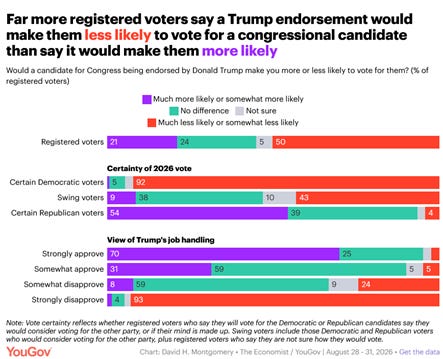
As Trump personalizes and nationalizes the midterms, YouGov polling finds that Trump endorsement often carries more baggage than boost. Half of registered voters, 50%, are “much less likely” or “somewhat less likely” to vote for a Trump-endorsed candidate. Among swing voters who will determine the outcome, most say his endorsement makes them less likely (43%) or “makes no difference (38%). Even among Republican likely voters, only 54% would make them more likely to vote for a Trump-endorsed candidate.
Democrats Worry About Trump’s Reaction
Democrats fear that a Trump midterm loss will result not in acceptance but in disruption -- using claims of fraud, emergency powers, federal pressure, or disinformation to undermine the legitimacy of their victory. They worry he could repeat patterns seen after past elections: contesting results, encouraging supporters to challenge certification, weaponizing federal agencies to create chaos around close races – fueling anger, amplifying false claims, and triggering the kind of unrest that culminated in the January 6 attack on Congress.
Some Democrats even fear that Majority Leader Mike Johnson, a deep MAGA, will refuse to seat Democrats in the House with false claims of election fraud.
Almost All Presidents Suffer Losses
Trump is also battling midterm history. Even overlooking Trump’s mistaken strategy of making the midterms orbit around him, only three presidents since World War II have seen their party gain House seats in a midterm. Very few have maintained full control of Congress. The historical pattern is overwhelmingly one of losses, not retention.
According to Gallup, incumbent presidential parties lose an average of 26 House seats post-WWII. That figure increases to an average loss of 35–37 House seats when the president’s job approval rating remains under 50%.
In Sum
Trump mistakes his 2024 base for a fixed asset instead of a shifting coalition that no longer matches yesterday’s map. Respected elections analyst Charlie Cook put it bluntly:
“…Republicans should brace themselves: The three most plausible outcomes are that it will be bad, really bad, or truly horrible. Conversely, a Democrat should at least briefly consider that the good fortune they may have in November will come compliments of the president, not as a result of much that they have done.”
###