

By Tom Bayles
Special to Tropic Press from WGCU News
This article was first published by WGCU News
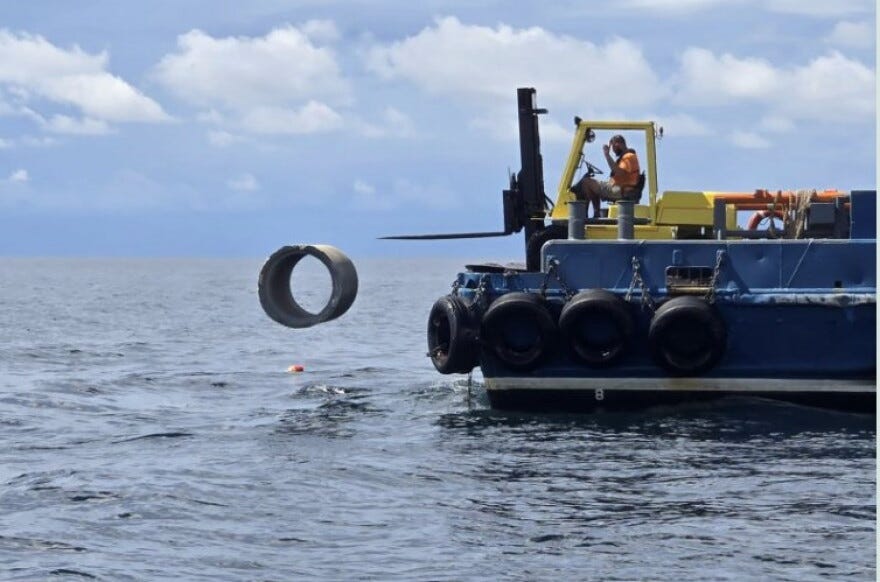
Two weeks after the Florida Coastal Corridor created an artificial reef off Naples, the nonprofit is sinking a second one offshore of Fort Walton Beach.
About 13 miles off Collier County, the foundation dropped 50 triangular, concrete structures made to become an artificial reef. In the Panhandle, the group is using three million pounds of concrete culverts.
“We basically will sink anything we can that provides safe, permittable habitat: balls to pyramids to transformer towers,” Nick Wiley, director of the Fish & Wildlife Foundation of Florida, said. “As long as it’s clean and safe, we’re ready to go ahead and put it in the water.”
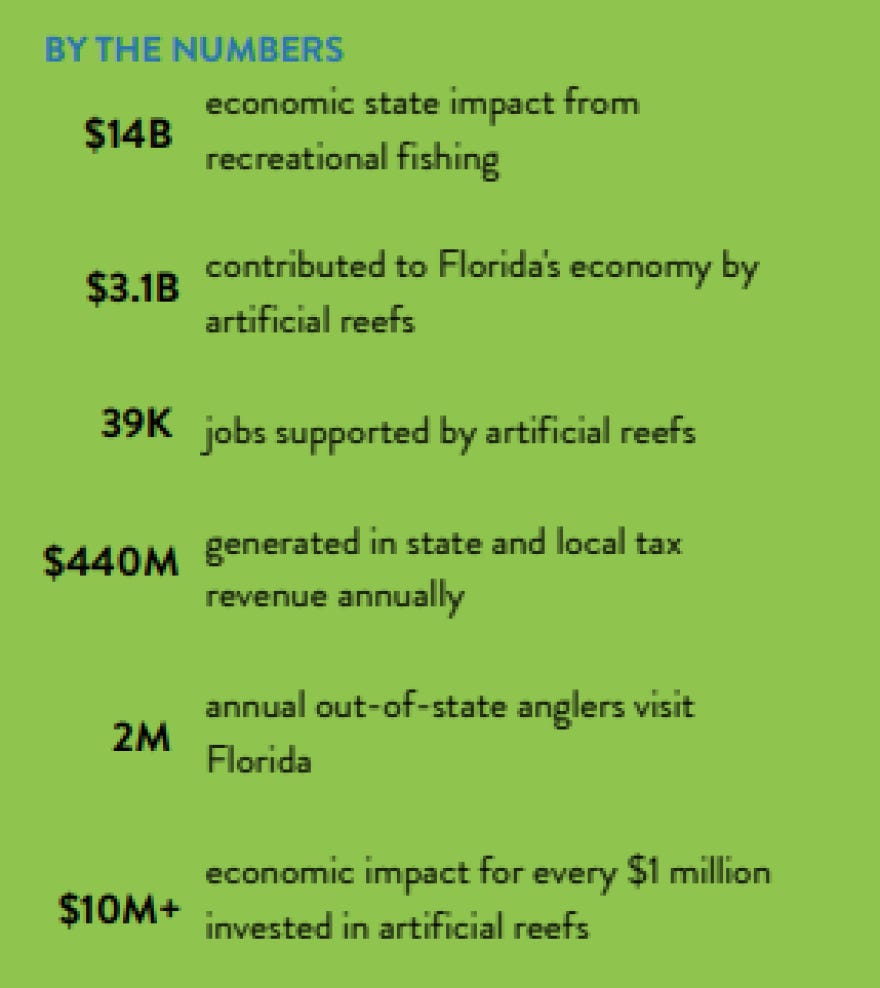
The Fish & Wildlife Foundation of Florida is spearheading the coastal corridor, which mirrors the Florida Wildlife Corridor that has secured more than 10 million acres of an expected 18 million acres for panthers, bears, and birds to travel up the state on land.
Wiley said various marine species have a similar need to have connected safe havens to feed, reproduce, and survive. The corridor of artificial reefs will become a fluid highway of sorts for the migratory fish and other marine species to move up the coastline safely.
The concrete culverts are being placed in concentrated configurations designed to create complex hard-bottom habitat.
Within weeks, an artificial reef acts like ghost town in reverse, going from bare concrete to a thriving community as plants attach and fish and other species move in.
The foundation is building reefs in the gaps between existing ones that many coastal Florida counties have already installed.

Environmental reporting for WGCU is funded in part by VoLo Foundation, a nonprofit with a mission to accelerate change and global impact by supporting science-based climate solutions, enhancing education, and improving health. WGCU is your trusted source for news and information in Southwest Florida. We are a nonprofit public service, and your support is more critical than ever. To help support public media consider making a donation here:
Thanks for your support
Since launching this newsletter a year ago, hundreds of thousands of subscribers have joined the Tropic Press community, making it one of the fastest-growing publications of its kind.
Our goal is to reach as many voters as possible so we can increase engagement in the political process and, hopefully, raise interest in voting this coming November. We do that through original reporting and by sharing stories such as this one today.
If you are encountering this newsletter for the first time, please consider subscribing. If you are already a subscriber, consider upgrading your subscription to help this work continue.
Regardless, every person you share this with is one more potential vote for change.
Please share and help us make Florida — and America — better for all of us.
Thanks.
J.C. Bruce
