

Voters in the midterm election made it clear they were dissatisfied with Donald Trump’s conduct and MAGA's direction. Yet Republicans are doubling down. Florida pollster Mark Schulman takes a deep dive into what this means for the 2028 presidential election.
By Mark Schulman
The post-midterm Republican race for the 2028 nomination is shaping up around one brutal problem: walking the fine line between claiming the Trump-loyal MAGA mantle without inheriting the verdict voters just rendered on his presidency. A Republican can win the 2028 nomination with MAGA support but lose the presidency along the way.
And Trump and the GOP show no signs of backing away from Trumpism. The Wall Street Journal reports that several people close to now-frontrunner JD Vance have told him that they no longer believe a Republican can win the election in two years given the drenching last week. Some longtime Trump donors are also now even starting to look elsewhere for someone to reshape the Republican Party, according to the newspaper’s reporting.
High-Wire Act
The feat for GOP contenders will be to preserve MAGA loyalty but also forge a new Republican majority -- all on an unforgiving timetable as the clock runs out. Early primary season starts in just a little more than a year with the January 3 Iowa caucuses.
Here’s why the nomination will be a require a political high-wire act:
Almost 2 in 3 Republicans – 63%-- said they wanted a continuation of Mr. Trump’s policies in mid-October New York Times polling.
Trump’s loyal but shrinking MAGA base will play an outsized role in 2028 primaries -- even after the midterm defeat. An August UMass Amherst national poll found that 68% of Republicans identified with MAGA: 31% “very much” and 37% “somewhat.” That is down from 77% in March.
MAGA voters in the 2026 midterm voter polls made up nearly a quarter of the entire 2026 electorate and voted Republican by a staggering 97–3 margin.
Donald Trump could remain something close to the financial gatekeeper of the 2028 Republican nomination. The last solid FEC figure I can verify is $164.3 million cash on hand as of October 14. He was still spending it down on the midterms. But he has signaled that he intends to keep replenishing it, preserving another potent lever over 2028.
No GOP Reset
The midterms delivered a blue tidal wave. Trump’s answer: more Trumpism – whatever that means. He’s dug in even further. And the post-midterm GOP has not turned the page on Trumpism.
House Republicans chose longtime Trump ally and highly partisan brawler Jim Jordan as their incoming minority leader immediately after their sweeping midterm losses.
Trump handed the White House to Stephen Miller, one of his longest-serving advisers and a key architect of his hardline and unpopular immigration policies.
Trump publicly defended his warrior-in-chief Pete Hegseth, the face of Trump’s increasingly unpopular Iran war. “…I think he’s doing a very good job.”
And, of course, to offer MAGA consolation for the drubbing, Trump reverted to his familiar fallback: if Republicans lost, the election must have been “rigged” and “they cheated.”
Who Wants the MAGA Crown?
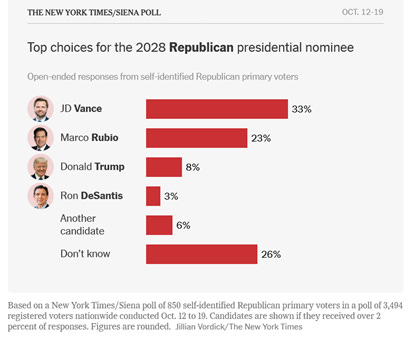
The midterms did more than rearrange Congress; they blew open the Republican race for 2028. Just before election day, JD Vance looked like the natural heir to Donald Trump, leading national GOP primary polling, with Marco Rubio generally his strongest rival. Vance led the Kalshi midterms prediction market as well.
But after the rout, Republicans began questioning whether being the administration’s heir is now a liability. We don’t have post-midterm polling numbers yet, but Vance does remain the top choice in the prediction markets. Markets are pricing in a succession fight as his stock slips. Marco Rubio has moved into the top tier, with soon to be Florida ex-governor Ron DeSantis’s stock rising in the prediction markets.
Recent pre-midterm polls have shown JD Vance leading Marco Rubio comfortably in some surveys, ahead or tied with Rubio in New Hampshire polls, but trailing him in another national poll.
To Be or Not To Be?
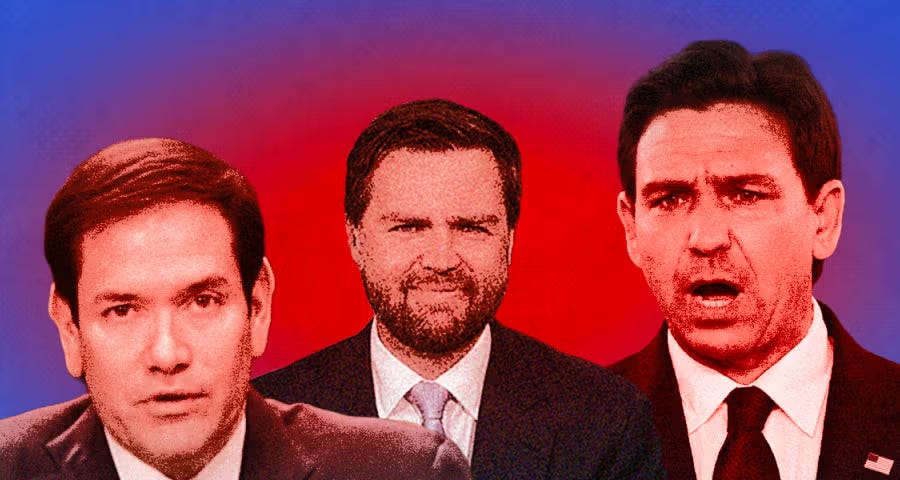
The three main prospective GOP candidates at the moment – JD Vance, Marco Rubio, and now Ron DeSantis -- would not be merely competing for the same voters. They need to offer different explanations for the midterm collapse and different versions of post-Trump Republicanism.
None has formally announced a campaign, even though the GOP mantle will be vacant soon. And it’s not so early in the game. But the reluctance may be a sign of the steep hill that any Republican would need to climb to win office in two years. Maybe initial denial is part of the ritual of running. All three will probably be in the running soon to lock up political and donor support.
Where Candidates Stand
JD Vance: the damaged frontrunner. He still leads the national GOP polling. But the midterm defeat has saddled him with the liabilities of the Trump administration. His immediate move has been to blame the Iran war for the losses, creating some distance from Donald Trump without abandoning Trumpism. Trump still publicly supports JD Vance, but their relationship shows growing political daylight. Trump called Vance’s post-midterm analysis “largely true.” Vance has also begun staking out his own positions on Israel and the GOP’s future. Trump hasn’t dumped Vance. He’s done something politically more unsettling: reopened the audition. Trump said he may not endorse anyone in the 2028 Republican primary.
Marco Rubio: the best-positioned alternative, but still coy. He is generally running second and remains one of the two principal names being discussed alongside Vance. He has said he has “no plans at this time” to run, and unlike Vance, he has defended Trump’s decision on Iran. That leaves him with an interesting lane: remain loyal, avoid an early break with Vance, and preserve his options. Rubio said,
“I don’t know what the future holds, but I have no plans at this time. I’m not a candidate for anything right now. And I’m 100% focused on my job, and I have to be because I have two jobs.”
Ron DeSantis: on the GOP dance card but with a lot of ground to make up. He remains far behind the leaders in national polling and in the prediction markets. But he is behaving like a potential challenger: After the midterms, he argued that Republicans had suffered something close to an “extinction-level event” and need to confront why they lost ground. His path would require turning the GOP’s defeat into an argument that the party needs something different from both the Trump administration and its designated heirs. The Kalshi prediction market moved Ron DeSantis’s nomination odds from below 5% before the election to roughly 17–19% afterward.
Vice-Presidents Have a Nominating Edge
Vice presidents have historically had a meaningful advantage in securing their party’s presidential nomination, although often less successful at winning the office.
Across U.S. history, 11 vice presidents have gone on to secure their party’s presidential nomination, while seven others sought it unsuccessfully. Here’s some recent history:
Richard Nixon, sitting VP, won the Republican nomination in 1960.
Hubert Humphrey, sitting VP, became the Democratic nominee in 1968.
George H. W. Bush converted the vice presidency into the Republican nomination and then the presidency in 1988.
Former VP Walter Mondale won the Democratic nomination in 1984, and sitting VP Al Gore did so in 2000.
Joe Biden showed that the vice presidency can be a launching pad even years after leaving office.
But winning the nomination and winning the presidency are different propositions. Political scientist John McGlennon characterizes vice presidents as “pretty successful at gaining their party’s nomination” but less successful at winning the general election. Both Mondale and Gore fell short.
In Sum
The midterms were a warning shot: reset Trumpism or fritter away 2028. Has the midterm crash created a hill too hard to climb for 2028? Moreover, Trump can anoint a successor without surrendering the kingdom — further weakening 2028 GOP chances.
Vance remains the front-runner for now. Pew Research examined seven open Republican nomination contests from 1960 through 2004, finding that the early GOP front-runner ultimately won six of seven nominations. Trump’s 2016 victory is the warning against treating an early frontrunner as inevitable: the race can reorder itself completely. Among Democrats, early leaders won only four of eight comparable contests.
Republicans have a history of nominating the early favorite. The problem for 2028: The midterms threw a wild card into a game that’s still taking shape. Even with time running short, the GOP must grapple with an unpredictable leader who retains his grip on the party.
Mark Schulman, Ph.D., is an award-winning pollster. He co-founded one of the nation’s largest survey research/polling firms, SRBI. He has worked extensively with news organizations, including serving as Time magazine’s pollster for almost ten years. This article was republished with his permission. You can support his work and subscribe directly to his Substack newsletter here:

A little help, please …
Beyond subscribing, one of the most helpful things you can do as a member of the Tropic Press community is to share this work with others. You can do that by hitting the SHARE button below (or simply forwarding this email) and also by hitting the RESTACK icon at the bottom of the post. It’s a lot smaller, but it looks like this:

Reposting sends these newsletters to other readers on the Substack network. And the more people we reach, the more effective we can be at changing the trajectory of our state and nation.

If Trump finishes out his term, JD Vance is the most likely candidate. Democrats need to nominate a known name who can take on these Republican losers and kick them out of DC.
Please not De Santis, please please please no. For me DeSantis makes Trumps money grabbing look like someone stealing your lunchmoney. De Santis.... thug and money grabber. Al Capone as president. Please no.