
COMMENTARY: Before Rubio and Vance spout off again, some words from the Popes
News and views for all Americans from a Florida perspective
By Bob Brecha
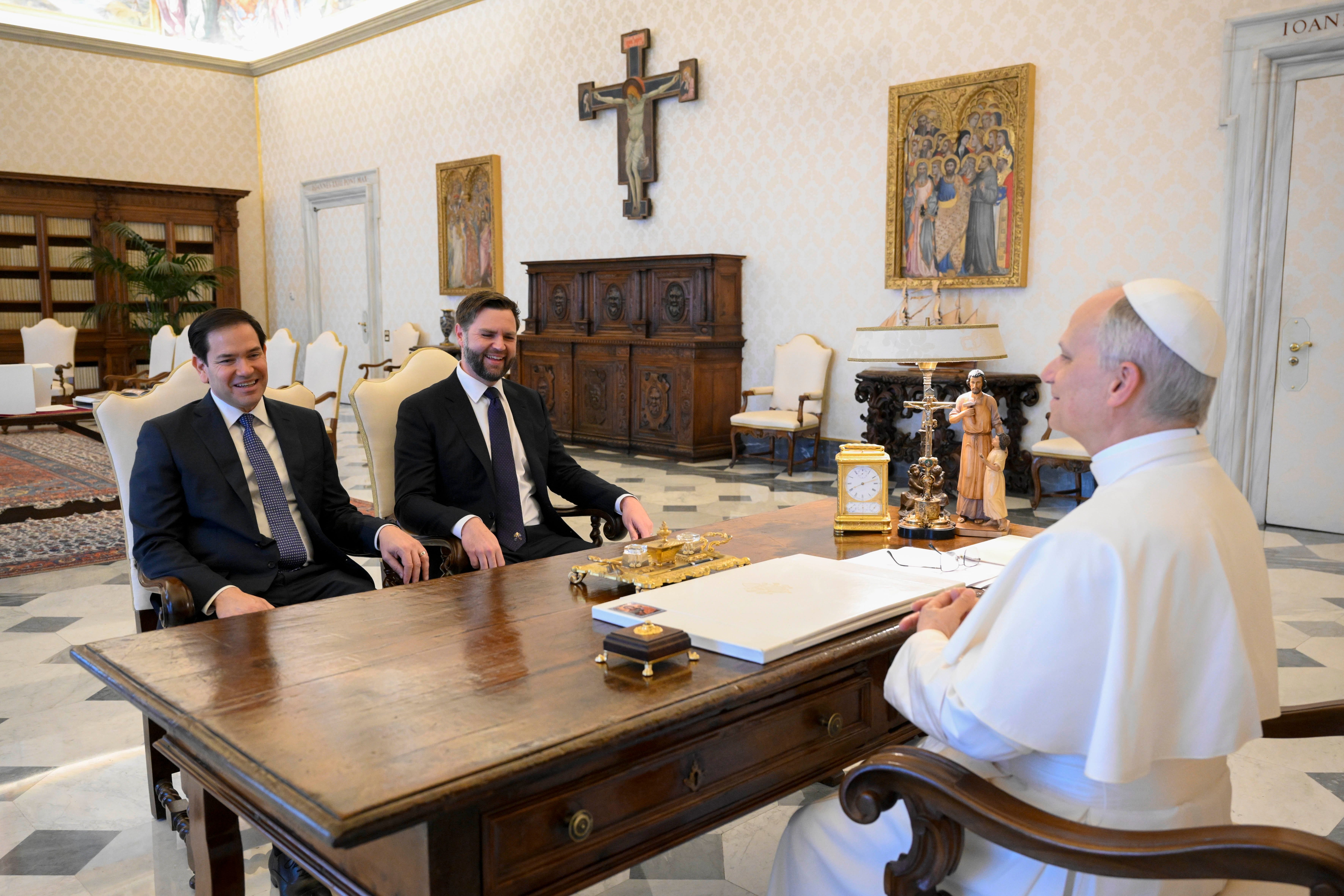
Marco Rubio is visiting Pope Leo XIV today to have “frank conversations” in the shadow of Donald Trump’s repeated attacks on the pontiff.
Pope Leo has made quite clear, unsurprisingly, that he and the church of which he is the leader do not support illegal aggression and unnecessary wars, and neither do they support country’s having nuclear weapons.
Rubio’s visit also comes after Vice President J.D. Vance chimed in a few weeks ago that the Pope should “be careful when he talks about matters of theology” and that he should be sure that his statements are “anchored in the truth.”
From my view here in Europe, and reading accounts and commentary in German and, especially, Italian newspapers, the sense of astonishment was palpable that a recent-convert U.S. politician would preach to the Pope about theological matters and the use of facts. Especially when this comes from a U.S. administration that has shown itself to have only a tenuous connection to facts in its own pronouncements.
About 20 percent of U.S. citizens are Catholic, and the same percentage of Floridians. After having taught at a Catholic university for three decades, and absorbing a certain amount of Catholic social teaching, I thought it might be interesting to gather here a series of quotes from Popes that might be somewhat surprising to most Catholics. I promise, none of these is from Bernie Sanders, Alexandria Ocasio-Cortez or Zohran Mamdani.
“The fact that some States, power groups and companies hoard non-renewable energy resources represents a grave obstacle to development in poor countries. … No one may appropriate surplus goods solely for his own private use when others lack the bare necessities of life. … the right of private property may never be exercised to the detriment of the common good.” (Benedict XVI 2009)
“The way humanity treats the environment influences the way it treats itself, and vice versa.” (Benedict XVI 2009)
“Everyone knows that the Fathers of the Church laid down the duty of the rich toward the poor in no uncertain terms. As St. Ambrose put it: ‘You are not making a gift of what is yours to the poor man, but you are giving him back what is his. You have been appropriating things that are meant to be for the common use of everyone. The earth belongs to everyone, not to the rich.’ These words indicate that the right to private property is not absolute and unconditional. No one may appropriate surplus goods solely for his own private use when others lack the bare necessities of life. In short, ‘as the Fathers of the Church and other eminent theologians tell us, the right of private property may never be exercised to the detriment of the common good.’ When ‘private gain and basic community needs conflict with one another,’ it is for the public authorities ‘to seek a solution to these questions, with the active involvement of individual citizens and social groups.’” (Pope Paul VI 1967)
“Once the demands of necessity and propriety have been met, the rest that one owns belongs to the poor” (Pope Leo XIII 1891)
“The stockpiling of natural resources, which in many cases are found in the poor countries themselves, gives rise to exploitation and frequent conflicts between and within nations. These conflicts are often fought on the soil of those same countries, with a heavy toll of death, destruction and further decay. The international community has an urgent duty to find institutional means of regulating the exploitation of non-renewable resources, involving poor countries in the process, in order to plan together for the future.” (Benedict XVI 2009)
“Sometimes globalization is viewed in fatalistic terms, as if the dynamics involved were the product of anonymous impersonal forces or structures independent of the human will. … Underneath the more visible process, humanity itself is becoming increasingly interconnected; it is made up of individuals and peoples to whom this process should offer benefits and development, as they assume their respective responsibilities, singly and collectively. … Hence a sustained commitment is needed so as to promote a person-based and community-oriented cultural process of world-wide integration that is open to transcendence.” (Benedict XVI 2009)
“It is likewise incumbent upon the competent authorities to make every effort to ensure that the economic and social costs of using up shared environmental resources are recognized with transparency and fully borne by those who incur them, not by other peoples or future generations: the protection of the environment, of resources and of the climate obliges all international leaders to act jointly and to show a readiness to work in good faith, respecting the law and promoting solidarity with the weakest regions of the planet.” (Benedict XVI 2009)
There might be a number of quotes by the same Popes with which I would not agree. And of course, there is nobody who can react with anything other than repulsion to the abuse scandals in the church.
However, when it comes to matters of the economy, the environment, and social justice, for more than a century at least, the Catholic Church has been quite consistent in its teaching about the need for international and social solidarity. In particular, solidarity should take the form of strong support to poorer countries by wealthier countries, who have both historically benefited from past exploitation of finite fossil fuel resources, as well as having contributed most to the climate crisis, for example.
Marco Rubio and J.D. Vance have their work cut out for themselves in trying to reconcile their militaristic and selfish version of Catholicism with the messages quoted above by “conservative” Popes, but succinctly expressed by Pope Francis (note that I have not quoted him thus far!) of the primary responsibility to “hear the cry of the earth and the cry of the poor.”
Bob Brecha is a retired professor of sustainability, renewable energy and physics (University of Dayton), and longtime newspaper junkie (print and electronic). He consults on energy systems and climate change policies, based in Berlin, Germany. When not fretting about the state of the world and the global climate emergency, he enjoys hiking, biking and reading as much as possible.
Thanks for your support
It’s easy to feel overwhelmed if you are a rational person living in the Free State of Florida, but there are plenty of smart, reasonable people just like you here. The purpose of this newsletter and the Tropic Press website is to provide a source of news and commentary that shines a light through this irrational fog. That includes contributions from correspondents here in Florida and around the globe, such as today’s article by Bob Brecha.
Thank you for your support as a subscriber. It is invaluable. This is especially so for those of you who have chosen to upgrade to paid subscriptions. Your contributions are making this possible.
J.C. Bruce
Share Tropic Press!
As this newsletter was written, Tropic Press was reaching more than 700,000 subscribers in Florida and elsewhere. But there are literally millions of Florida Democrats and independents we are not reaching yet.
That’s a problem you can help solve.
With mid-term elections on the horizon, the more people we reach, the more effective we can be in helping turn our state and this country around. You can play a vital role in that effort by sharing this newsletter with friends.
If you are reading this as an email, simply forward it. Or you can use the link below. Thanks.


