

By Michael Barfield
Special to Tropic Press from Florida Trident
The grand jury report that put Attorney General James Uthmeier at the center of a “sophisticated scheme” to move $10 million from a Medicaid settlement into his political committee was erased this week by a state appeals court, in an appeal in which no one was allowed to argue in defense of the report, the court’s own opinion shows.
The lawyers who won without any opposition include two firms Florida taxpayers have paid more than $300,000 in the grand jury matter, one of them appearing for Uthmeier himself. And new records show a third firm on the public payroll: hired by Gov. Ron DeSantis’ office 12 days before the Leon County grand jury began hearing witnesses, to stand beside a witness the governor’s office still will not name.
The invoices, obtained by the Florida Trident, add a new layer to the scandal consuming the closing months of the DeSantis administration: $10 million from the state’s settlement with Centene, routed through the Hope Florida Foundation and two nonprofits to a political committee run by James Uthmeier, then the governor’s chief of staff and now the attorney general, who is on the Nov. 3 ballot, where voters will have a say over the controversy.
A grand jury found the money “misappropriated as part of a sophisticated scheme to fund political activities.” It placed Uthmeier at the center: “in a position of authority over those involved in settling with Centene,” the report found; one of the nonprofits applied for its $5 million on Uthmeier’s “direct instruction”; and his political committee was “the prime recipient of the majority of the $10 million taxpayer funds.” The grand jury charged no one.
In throwing the report out, the First District Court of Appeal held that a grand jury “may not declare conduct unlawful and then decline to charge it, and it may not condemn people by name without indicting them,” Judge Lance E. Neff wrote for the majority. He was joined in full by Judge M.K. Thomas, ordering the report expunged in its entirety. Neff was appointed to the court by DeSantis on March 2, 2026.
The $10 million “was never public money,” the court said, and the Legislature “has not made such action illegal.” The opinion fails to mention or reconcile that the state itself characterized the $10 million as public money when it reimbursed the federal government for the entire amount.
Florida’s grand jury statute keeps a report like this one confidential until “the individual concerned” has been “furnished a copy thereof and given 15 days to file” a motion to repress or expunge it. The opinion faulted State Attorney Jack Campbell’s office for sending the presentment in two mass emails to 49 recipients on Jan. 28 and 29, including Rep. Alex Andrade, the complaining witness, a disclosure the court called “the State’s own doing” and an independent ground for expungement. The holding that Campbell’s emails violated the statute rests on reading “the individual concerned” to mean only those the report impugns, a limitation the statute’s text does not contain, and one no party was present to contest.
The ruling is not final until any motion for rehearing is decided. It came in an appeal that was, by the opinion’s own account, one-sided: the opinion records no argument from anyone in the report’s defense.
The legal bills
The governor’s office answered the Leon County investigation, the records show, with lawyers: three firms and $327,170.50 in public money so far, to represent the office and the witnesses it chose to cover, and, by the invoices’ own account, to go to court to keep the grand jury’s report hidden.
Wednesday’s opinion lists the lawyers for those who appealed, and one listing stands out. Christopher Kise of Continental PLLC, the firm whose invoices name the governor’s office as its client, appears as counsel for Uthmeier. Boies Schiller Flexner appears, as the Trident has reported, for Katie Strickland. A third firm on the governor’s tab, Komisar Spicola, is not listed in Wednesday’s opinion. But an Aug. 25 order in a companion case shows it was in the appeals court: William Spicola and Adam Komisar represented an anonymous “Petitioner F” in the emergency petition that kept the Trident from being told the appeal existed.
The Continental invoices the governor’s office has released run through May, before the appeal; whether the office is paying for the attorney general’s appeal, those records do not show, and whom Kise represented in the circuit court, the invoices do not say. The state itself, with Uthmeier a party, appeared through specially appointed counsel acting as attorney general.
The billing isn’t finished. In July, after the hearing, the governor’s office issued Komisar Spicola a second $20,000 purchase order, “a continuation” of the first, and gave Boies Schiller a new purchase order for the fiscal year that began July 1, with $106,212.50 still unspent after two payments in August. The emergency petition in August, the appeal itself and whatever follows it, a motion for rehearing or a trip to the Florida Supreme Court, will be billed on invoices the governor’s office has not released.
Komisar Spicola is the third firm the Trident has identified and the first one hired, on Oct. 2, 2025. As previously reported, Boies Schiller Flexner, representing former deputy chief of staff Katie Strickland, and Continental PLLC, whose invoices name the governor’s office itself as the client, were not engaged until Oct. 30.
In response to a public records request by the Trident for the Boies Schiller invoices, the governor’s office said, “there are no responsive public records that can lawfully be produced at this time.” It also described the material as “work product” that cannot be released until the legal proceedings are final.
Nothing in the Komisar Spicola invoices identifies the firm’s client. They do show that the governor’s office hired the firm, approved its bills and paid them: $20,130.50 over seven invoices, in four warrants between Jan. 30 and July 21, 2026, under two purchase orders, the first issued at the direction of the governor’s then-general counsel, Ryan Newman.
Using taxpayer money to pay a public employee’s lawyer for a grand jury appearance is barred by a longstanding attorney general’s opinion still posted on Attorney General James Uthmeier’s website.
The governor’s office did not respond to questions about the invoices or the identity of the client in the Komisar Spicola invoices.
The billing entries themselves leave little doubt about the subject. They include references to communications with the State Attorney’s Office, including entries such as “SAO interviews and GJ,” “Meet with client at courthouse, stand by for GJ” and calls related to “GJ and investigation process.”
“These entries are consistent with a lawyer representing a witness before a grand jury and communicating with a prosecutor about scheduling,” said Andrea Flynn Mogensen, a board-certified criminal defense lawyer who reviewed the invoices.
SAO is the State Attorney’s Office, GJ the grand jury. The dates match, to the day, the sessions at which the Tampa Bay Times and Miami Herald reported Hope Florida witnesses arriving at the Leon County Courthouse.
Nellie King, a criminal defense lawyer and past president of both the National Association of Criminal Defense Lawyers and Florida Association of Criminal Defense Lawyers, reviewed the invoices at the Trident’s request to better understand the entries. “It is the practice for law firms to adopt shorthand in its billing procedures for ease of timekeeping. In this context, GJ is an initialism for Grand Jury.”
The first invoice indicates a two-week preparation of a witness, including entries for meetings with the client on Oct. 7, 9 and 13; a call to the State Attorney’s Office and a message left for “JC” on Oct. 8; “Email back from JC re 10/14” on Oct. 13; “Texts from JC re time today, respond to coordinate” on the morning of Oct. 15; and then, that day, Adam Komisar’s two hours to “Meet with client at courthouse, stand by for GJ” and William Spicola’s 6.2 hours, “Hearing.”
The “JC” referenced in the billing entries matches the initials for State Attorney Jack Campbell, whose office was running the grand jury. Both lawyers know him. The firm’s website says Komisar and Spicola prosecuted together under former State Attorney Willie Meggs alongside Campbell. In 2022, Komisar was appointed by Campbell to an advisory group.
Campbell’s office did not respond to questions. Neither Komisar nor Spicola returned inquiries.
Oct. 15, 2025, was the grand jury’s second day. The only witness the Tampa Bay Times reported seeing that day was Joshua Hay, the Hope Florida Foundation’s former chairman, photographed leaving the courthouse around noon with a lawyer the paper did not identify. The Trident compared the photograph with law firm websites: the lawyer with Hay appears to be Barry Kamar, a King & Spalding partner who spent more than a decade as a federal prosecutor and SEC lawyer.
Kamar and Hay did not respond to inquiries.
After the presentment
The grand jury’s report was filed under seal on Jan. 28, 2026. Under Florida law, a person named in a presentment has 15 days to ask the court to repress or expunge it. The fifteenth day was Feb. 12. In February, the opinion confirms, “the named movants moved to repress and expunge.”
Komisar Spicola’s bills, read alongside the other two firms’, trace what happened next. In the week of Feb. 9, all three firms were drafting legal documents. Continental’s Christopher Kise billed “Consideration/analysis regarding draft Motion to,” the rest blacked out, and Boies Schiller’s Jesse Panuccio and the two Komisar Spicola lawyers billed calls the same day.
On Feb. 12, the day of the deadline, Boies Schiller billed “Finalize,” Continental “Revise/finalize,” and Komisar Spicola “Finalize,” “Final edits” with another notation of “Hand file,” an unusual indication that the filing was not filed electronically but hand-delivered to a judge. Two weeks later a Continental entry refers to “SA Response to Motions to Repress,” indicating that more than one motion to keep the grand jury’s report secret was filed.
On March 6, Continental’s Lazaro Fields billed a “Privileged common interest discussion” and Kise a “Counsel conference call”; Panuccio and his colleague David Costello billed a call of similar length that day. “Common interest” is the term lawyers use when separately represented parties agree to share privileged material without waiving the privilege. Boies Schiller and Continental finalized replies on March 9.
The governor’s own payment records show joint motions and draft orders exchanged on March 30, an order in circulation on April 2, and a hearing held in early June.
The hearing
Collectively, the billing records of all three law firms show preparation for a hearing held on June 2. On May 26, Spicola billed “Finalize and file” without identifying what was filed in court. The next day, five lawyers at the three separate law firms each billed roughly an hour. Komisar’s entry reads “Zoom hearing Prep Call,” Spicola’s “Hearing preparation call.” The other lawyers’ billing entries also indicate the Zoom call was in preparation for a hearing.
On June 2, a hearing of roughly four hours was held in an effort to keep the grand jury report secret. The order came July 29. Circuit Judge James Lee Marsh repressed and expunged the witness summaries, the witnesses’ names and titles, all 97 pages of attachments and several findings, roughly 112 of the report’s 116 pages, but declined to expunge it in full, finding that the redactions did not change its tenor. The appeals court gave the appellants the other four pages on Wednesday.
No order closing the hearing or sealing the file has been published, although the rules of judicial administration require the clerk to post any order that makes court records or hearings confidential.
An appeal without an adversary
The appeal that erased the report had no one on the other side to defend it. On Wednesday the appeals court said that grand jury secrecy “extends to matters ancillary to the grand jury session, including a motion to expunge a presentment,” and reversed what it described as three orders, entered March 25, July 8 and Aug. 6, requiring the State Attorney to notify the Trident’s publisher, an intervenor in the case, of any appeal.
State Attorney Jack Campbell, whose office had opposed the motions in the circuit court, appealed the partial expungement and then dropped his appeal after the report was published. That left “the State,” meaning Uthmeier’s office, as the only party opposite the appellants, who included Uthmeier himself. To solve the odd problem of Uthmeier being on both sides of the arguments, the State appeared through Bradford L. Thomas as “specially appointed counsel performing the duties of the Acting Attorney General.” Thomas previously served on the same appellate court but resigned in February 2025 after 20 years on the bench. He was assisted by two chief deputy solicitors general, lawyers from the office Uthmeier runs.
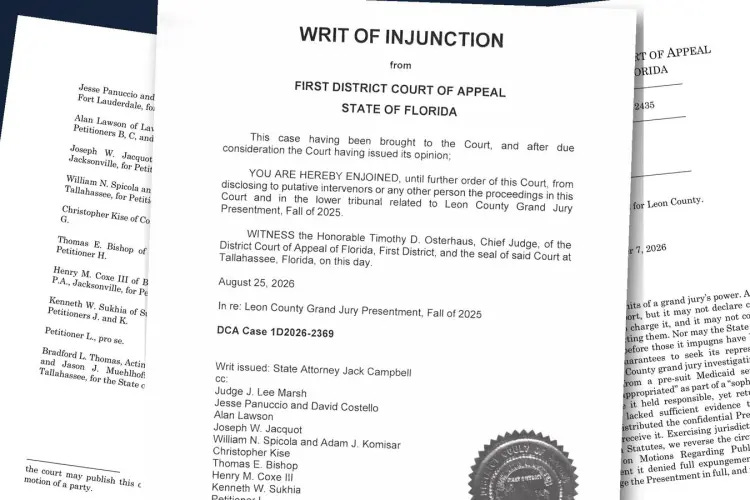
The notification requirement had been frozen since August. On Aug. 12, the people named in the report asked the appeals court for emergency relief; the court stayed the orders the next day, and on Aug. 25 a panel of Judges Rowe, Bilbrey and M.K. Thomas granted the petition. The resulting writ of injunction, issued in the name of Chief Judge Timothy Osterhaus and personally served on Campbell, bars him from disclosing “to putative intervenors or any other person the proceedings in this Court and in the lower tribunal.” The court’s ruling stated that, if notified, the intervenors “would learn of the existence of the grand jury proceedings and the presentment.”
The intervenors included the Florida Center for Government Accountability, which publishes the Trident, and its executive director, the author of this story. The circuit court had allowed them into the case for a limited purpose, and ordered that they be told of any appeal. Telling them about an appeal in a case they were already part of, the order said, would “negate Petitioners’ potential appellate remedy.”
The Aug. 25 ruling was issued as an unpublished opinion and, by its own terms, remained unpublished until late Wednesday.
Uthmeier’s office did not oppose the gag. “The State concedes that the petition should be granted,” the Aug. 25 order says. The State in that case was represented by Thomas and the same two chief deputy solicitors general from Uthmeier’s office. Kise, whom Wednesday’s opinion identifies as Uthmeier’s lawyer, appeared on the other side for one of the petitioners.
The opinion recites no argument from the State in the presentment’s defense. It records the State “agreeing” to the reversal of the requirement that Campbell notify the Trident’s publisher of any appeal, “the point unopposed” because the intervenors were not parties to the appeal and had not been notified of it.
The opinion also extends relief to Amy Ronshausen and Save Our Society From Drugs, who moved to repress in the circuit court but did not appeal. And it came fast. The court received the record on Sept. 9 and ruled on Oct. 7, four weeks later and 27 days before the election in which Uthmeier is on the ballot; under the appellate rules’ ordinary schedule, the briefs alone take more than four months.
The third judge on the panel, Ross Bilbrey, would have expunged the report on the disclosure ground alone, “without reaching the substance of the Presentment.”
In a footnote, the majority added that the disclosure of the report “may itself have violated section 905.27(1) and (2),” the state law that makes revealing grand jury testimony a crime, while expressing “no view on the lawfulness of its publication by the press.”
A seat on the gaming commission
On Jan. 9, 2026, Gov. Ron DeSantis appointed Spicola to the Florida Gaming Control Commission, a four-year appointment that requires Senate confirmation and pays $158,094 a year. The governor’s announcement identified Spicola as “an Attorney at Komisar Spicola, P.A.” and a member of the Second Judicial Circuit Judicial Nominating Commission. It did not mention that the firm was, that week, under contract to the governor’s office in the grand jury matter.
The same day Spicola was appointed to the gaming commission, the governor’s contract manager signed the state form accepting the firm’s first invoice.
Spicola’s first meeting as a gaming commissioner was Feb. 5, 2026, eight days after the grand jury’s report was filed and a week before the Feb. 12 deadline. He publicly thanked “the governor for putting his trust in me to take care of this position,” according to a transcript.
The judicial nominating commission Spicola chaired at the time also intersects with the Hope Florida matter. On Jan. 16, 2026, the Second Circuit JNC announced the process for the seat of retiring Judge John C. Cooper, with applications due Feb. 2, interviews Feb. 20 and nominees to the governor by Feb. 22.
One of the nominees was Andrew Sheeran, the Agency for Health Care Administration (AHCA) general counsel who drafted the Hope Florida provision into the Centene settlement and whose legal justification for it the grand jury rejected. Across those same dates, Spicola was billing the governor’s office in the proceeding over the report that criticized Sheeran. On March 16, the governor appointed Sheeran to the bench.
Spicola’s billing entries do not indicate whether Sheeran or AHCA was the firm’s client. Sheeran was among those who appealed; the opinion lists Joseph Jacquot of Gunster, a former general counsel to DeSantis, as his lawyer, not Komisar Spicola.
What is still sealed
The bills do not name the client, the motions, or the hearing. Collectively, they establish that three sets of taxpayer-funded lawyers, for three clients, moved together from the Feb. 12 deadline to the June 2 hearing. The court file that would say what they filed, and what the court ordered, remains closed. Wednesday’s opinion supplies the outline: motions to repress and expunge in February, a hearing, the July 29 order, an emergency petition in August that produced a writ barring the State Attorney from disclosing the proceedings to the intervenors or anyone else, and now full expungement.
The opinion narrows the question of the third firm’s client without answering it. It lists counsel for Strickland, Uthmeier, Sheeran, Jason Weida, John Guard, who represented himself, and for Mark Wilson, Frank Walker and Secure Florida’s Future, represented by Alan Lawson, a former Florida Supreme Court justice. Amy Ronshausen and Save Our Society From Drugs moved to repress but did not appeal.
Komisar Spicola represented none of them in Wednesday’s decision. But the Aug. 25 order lists 12 anonymous petitioners, A through L, and their lawyers. The lawyers for eight of them match the appellants’ lawyers in Wednesday’s opinion. Four do not: Petitioner F, represented by Spicola and Komisar; Petitioner I, represented by Henry M. Coxe III of the Jacksonville firm Bedell, Dittmar, DeVault, Pillans & Coxe; and Petitioners J and K, represented by Kenneth W. Sukhia of Tallahassee. Whoever the firm’s client is, it joined the August effort to keep the appeal secret but is not among those listed when the appeal was decided.
The report that law firms were paid to keep under seal became public anyway in late August, when CBS News Miami obtained a copy, a day after Campbell was served with the appeals court’s writ barring him from disclosing the proceedings.
Who’s who in this story
William Spicola — Komisar Spicola partner hired by the governor’s office 12 days before the grand jury met. Appointed by DeSantis to the Gaming Control Commission ($158,094 a year) while under contract. Represented “Petitioner F” in the August gag petition.
Adam Komisar — Spicola’s partner; billed to “stand by for GJ” at the courthouse. Prosecuted alongside Campbell under Willie Meggs.
Jack Campbell — State attorney who ran the grand jury; the “JC” in the invoices. Emailed the report to 49 recipients, dropped his appeal, and is now under a writ barring disclosure.
Judge Lance E. Neff — 1st DCA judge appointed by DeSantis March 2, 2026; wrote the opinion expunging the report in full.
Judges M.K. Thomas and Ross Bilbrey — Thomas joined Neff in full; Bilbrey would have expunged on the disclosure ground alone. Both sat on the panel that issued the August writ.
Judge James Lee Marsh — Leon circuit judge; his July 29 order expunged about 112 of 116 pages but refused to erase the rest.
Bradford L. Thomas — Former 1st DCA judge appointed to act as attorney general for “the State,” which conceded the August petition.
James Uthmeier — Attorney general, on the Nov. 3 ballot. An appellant represented by Kise while his own office represented the State.
Chris Kise — Continental PLLC lawyer; the firm’s invoices name the governor’s office as client. Counsel for Uthmeier on appeal.
Katie Strickland — Former DeSantis deputy chief of staff; represented by Boies Schiller Flexner at taxpayer expense.
Andrew Sheeran — AHCA general counsel who drafted the Hope Florida provision. Nominated by the JNC Spicola chaired; appointed a circuit judge March 16.
Henry M. Coxe III, Kenneth W. Sukhia — Lawyers for unidentified Petitioners I, J and K in August, none listed in the final appeal.
Ryan Newman — Governor’s then-general counsel who directed the first Komisar Spicola purchase order.
Ron DeSantis — Governor; his office has paid three firms $327,170.50. Appointed Spicola, Sheeran and Neff.
Michael Barfield is an award-winning investigative reporter who helps strengthen transparency and accountability across Florida. He assists reporters and the public with public records questions and requests, and he oversees and supports the organization’s litigation to enforce open government. He’s a frequent lecturer on Florida’s Public Records Act and Sunshine Law, serves on the governance committee of Investigative Reporters & Editors, and is a member of the Society of Professional Journalists. Barfield is a former President of the ACLU of Florida, a life member of the Florida Association of Criminal Defense Lawyers, and has twice been named by Sarasota Magazine as one of the most influential people in Sarasota. He lives in Sarasota with his wife, Iru.

The Florida Trident is an investigative news outlet focusing on government accountability and transparency across Florida. The Trident was created and first published in 2022 by the Florida Center for Government Accountability in the wake of shrinking newsroom budgets and staff across the country. This article is published with the Trident’s permission. To support the Trident’s work, click here:
Please share this
A major goal of this newsletter is to reach as many Floridians as possible, raise interest in civic affairs, and encourage voting this coming November.
Every person you share this with is one more potential vote for change.
Please share and help us make Florida — and America — better for all of us.
Thanks.
J.C. Bruce

Thanks for great reporting. Taxpayers deserve it!
Thanks for spreading the word. We need to shine some light on this corruption. I have shared it with my network.