

Democratic candidates for Florida Legislature need our help. Here's how to do it
It's crucial to break up the Republican monopoly in state government. It starts by making sure voters have alternatives on the ballot. Those candidates need our support.
By J.C. Bruce
During the past half-dozen years, the Florida Democratic Party has seen a precipitous decline in registered voters.
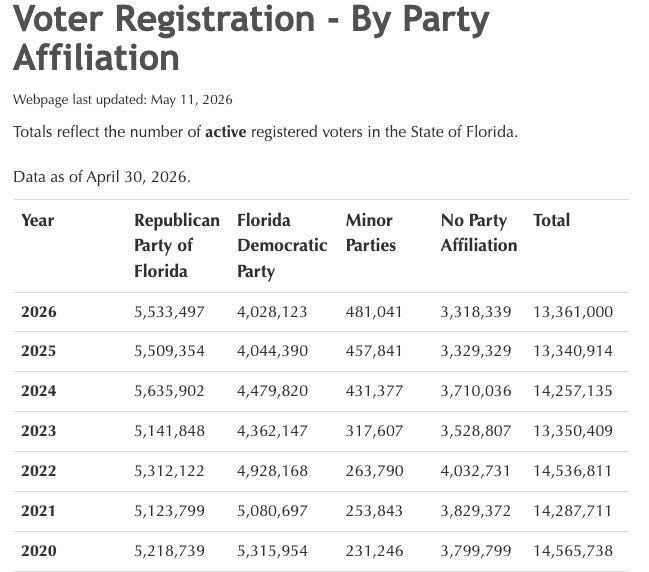
While newcomers may find this hard to believe, as late as 2020, Democrats outnumbered Republicans in this state — 5.3 million to 5.2 million. Contrast that to today, where Republicans dominate with 5.5 million registered voters versus 4 million for the Dems.
What’s so concerning about those numbers to me isn’t just that Republicans surged ahead, but that both Democrats and independent voters lost actual numbers by the hundreds of thousands, all while Florida’s population was booming, gaining about 2 million new residents.
Indeed, over that period, the total number of Floridians registered to vote dropped by 1.2 million overall, according to figures posted by Secretary of State’s office (below). And it looks like, in balance, Democrats and independents were the ones suffering the decline, while in real numbers Republicans gained.
There are a host of factors that have played into this, including voter suppression laws passed by Republicans that especially impacted Democrats and independents, purging from voter rolls about a million people who had not voted in recent years. Then there are demographic shifts with newcomers to the state bringing their party loyalties with them.
Even so, were we to look at this in, admittedly, oversimplified terms, and examine the fortunes of the state’s political parties as, say, businesses, it’s clear that the G.O.P.’s stock has been rising while the Democrats have been tanking.
While that’s gloomy, there’s a sense that the momentum may be shifting. Dems are touting local wins, like the Miami mayoral race and a few legislative special elections. And with the Republican Party’s standard-bearer, Donald Trump, plummeting in the polls, there’s newfound optimism about the midterm elections.
But number are numbers. To overcome Republicans’ voter registration lead, Democrats will need the support of independents and voters registered to minor parties (whose numbers, interestingly, have doubled over the past few years).
Given the fix the party finds itself in, it seems fair to ask—notwithstanding factors outside the party’s control—how well it is facing these challenges.
The last time the Democratic Party was leading was during the tenure of former party Chair Terrie Rizzo in 2020. Since then, that seat has been filled by Manny Diaz, the former mayor of Miami, and now, Nikki Fried, the state’s former agriculture commissioner, who presides over a gaping voter deficit.
Is enough being done to reverse this downward trend?
This concern is prompted, in part, by a recent story published by the USA Today network noting friction between the party’s established leaders and volunteers who have been recruiting candidates for office.
One example cited was that of U.S. Navy veteran Brian Nathan, who won a special election in Senate District 14 by half a percentage point:
Nathan … said he didn’t have the support of the state Democratic Party. “They wanted me to replace my staff. They wanted to review every single contract I had. They wanted to control the campaign, essentially,” he said. “I was happy to be a partner and work with them, but I was not willing to turn over the keys to my campaign to them.”
And it seems like it was a good thing he didn’t.
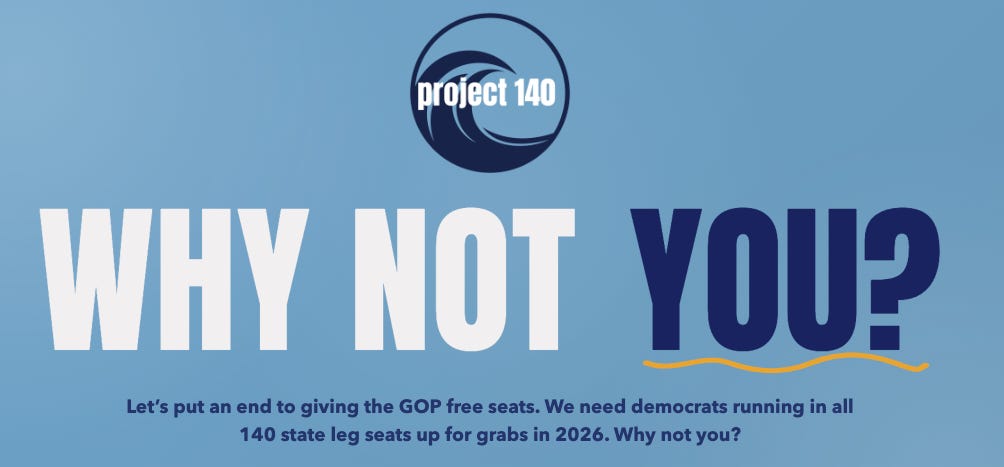
Frustration with the state party organization was also discussed by volunteers such as Margie Stein, the leader of Project 140, who has successfully recruited dozens of candidates in the past few months to run for either the state House or Senate.
For her efforts, Fried accused Stein of not being a “team player” because she would not release the names of people she was trying to recruit.
Why?
“She wanted to know who we were talking to,” Stein said. “I don’t understand what she would want them for. If the Florida party was doing what it should be doing, we wouldn’t have to be doing what we’re doing. Her charge is ridiculous.”
As she told USA Today: “Grassroots groups like ours are the future of politics. How do you win elections if you don’t participate? And why would you just hand the keys to the kingdom to the Republicans without a fight?”
So, is Stein’s political committee, Blue Florida: Project 140, in competition with the party?
“I don’t profess to be the competition. I’m filling a gap. There’s a hole in the system.”
The good news is that the hole is being filled. Stein says that most of the legislative seats that only a few months ago had no Democratic candidates now have volunteers ready to sign their qualifying papers. The deadline is June 12.
But it takes about $1,800 per candidate to register.
“We need about $40,000,” Stein said, money to bridge the gap between what the candidates have on hand and what they need.
As noted in this space before, Project 140 derives its name from the number of state House and Senate seats up for grabs in the November election.
By finding Democratic candidates for these seats, it “keeps Republicans busy” and forces them to campaign more vigorously in their own districts rather than helping out in statewide elections such as for U.S. Senate and governor, Stein says.
“They get nervous as soon as they get an opponent. We want them nervous.”
If Democrats can add just a few seats to the House and Senate this year, they can take away the Republicans’ supermajority status in the Legislature. Why is that important? Because right now, the Republicans have the numbers to override any veto by the governor. Take that away, and they would be forced to come to the table and negotiate. And if the Democrats are successful in electing a governor, this would be a game-changer.
You can help with that by pitching in so Democratic candidates reach their fundraising goals to qualify to run.
That might just be the spark the Democratic Party needs to turn its fortunes around. Every small donation adds up.
Here’s where to do it:
J.C. Bruce is the founder of Tropic Press, a newsletter and website reaching more than 700,000 Floridians daily. He is an award-winning journalist and author, a native Miamian, and an alum of the University of South Florida among other institutions of higher learning where he served time.
Thanks for your support
It’s easy to feel overwhelmed if you are a rational person living in the Free State of Florida, but there are plenty of smart, reasonable people just like you here. The purpose of this newsletter and the Tropic Press website is to provide a source of news and commentary that shines a light through this irrational fog.
Thank you for your support as a subscriber. It is invaluable. This is especially so for those of you who have chosen to upgrade to paid subscriptions. Your contributions are making this possible.
J.C. Bruce

Share Tropic Press!
As this newsletter was written, Tropic Press was reaching more than 700,000 subscribers in Florida and elsewhere. But there are literally millions of Florida Democrats and independents we are not reaching yet.
That’s a problem you can help solve.
With mid-term elections on the horizon, the more people we reach, the more effective we can be in helping turn our state and this country around. You can play a vital role in that effort by sharing this newsletter with friends.
If you are reading this as an email, simply forward it. Or you can use the link below. Thanks.
Yes, it would be better for everyone (and the world) if the Republican juggernaut were stopped. I would love to see the Democratic Party doing that; however, a party of warmongers for Israel or for the Ukraine, a party that is as corporate as any Republican, and a party that is as much chained to big donors as anyone, just may not be much of a success. When I was young, the Democrats were the party of working people and the New Deal; if it can return to its roots, hands down it can chain down the elephant.
Done! We have been sharing in Pasco to try to find someone to run against Chris Nocco for the Senate opening. Fingers crossed on a candidate coming through!!!