

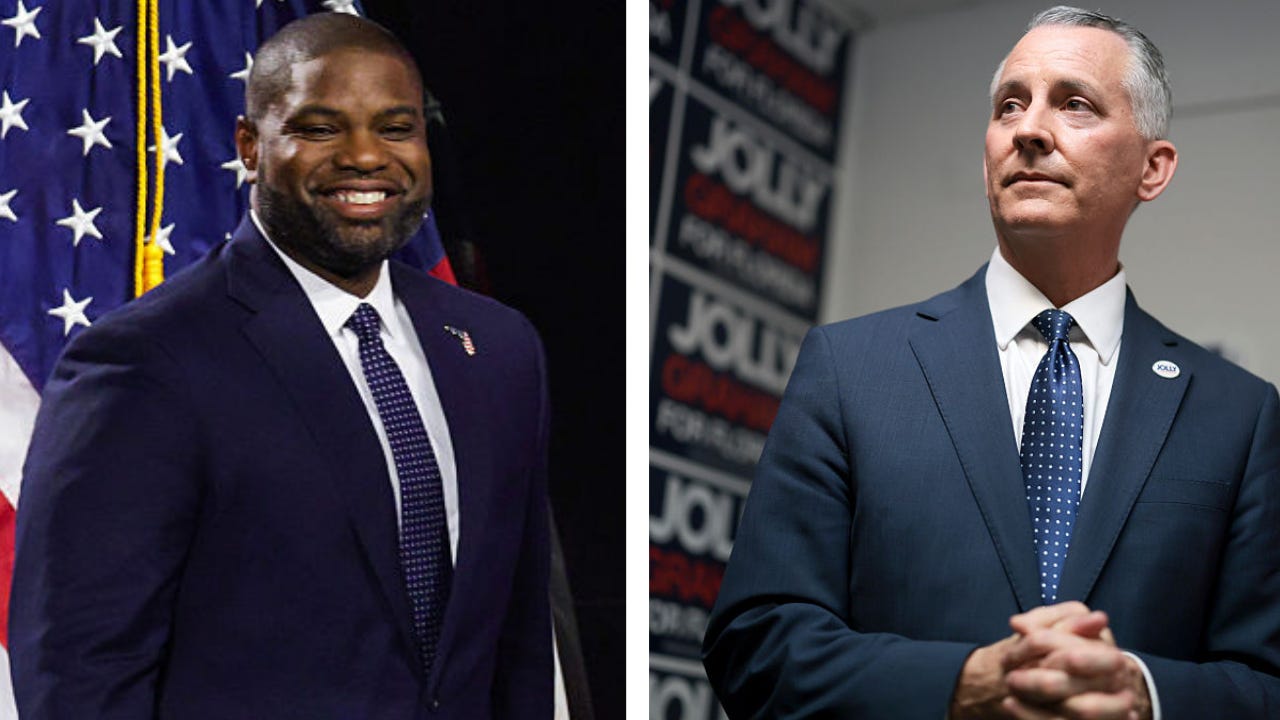
This issue of Tropic Press presents two looks at where Republican G.O.P. candidate Donalds gets his money. The first, from Open Secrets, examines his and Democrat David Jolly’s campaign fundraising and who is donating. In Donalds’ case, it’s mostly special interests. The second, an excerpt from a Tampa Bay Times and Miami Herald report, looks at the growth of Donalds’ personal wealth—largely through his wife’s charter school business. Were Donalds to win, for the first time, Florida could have a leader whose family wealth is tied to the flow of taxpayer funds to the private charter school management industry.
By Claire Cleary
Special to Tropic Press from Open Secrets
As polls show Democrats poised to win control of the House of Representatives and possibly the Senate, the party is also hoping to flip gubernatorial seats in November. But in GOP-dominated Florida, they will need to overcome a big funding gap to do so.
As of Oct. 20, more than $170 million has poured into Florida’s race for governor, where both candidates have pulled in donations from billionaires, super PACs and corporations. Even though recent polls show Democrat David Jolly, a former Republican House member, close behind Rep. Byron Donalds (R), Florida Democrats still face an uphill fight to elect their first governor in 32 years.
According to an OpenSecrets analysis of campaign finance records, Donalds holds $33.3 million more in cash on hand for the final sprint to Election Day, fueled by billionaires, gambling interests, private detention companies and the AI industry.
‘Loophole’ laws allow for effectively limitless donations
This race is not the first Florida gubernatorial contest in which donations have climbed into the hundreds of millions – in 2022, Gov. Ron DeSantis (R) raised nearly $200 million, while his opponent Charlie Crist (D) raised $28 million.
But the candidates aren’t raising these millions in their individual campaign committees. State campaign finance laws limit the amount of money a candidate can receive from a single donor to $3,000. However, candidates are allowed to establish affiliated political action committees that can receive unlimited donations from individuals, corporations and political organizations.
“This is just a gigantic loophole,” said Aubrey Jewett, associate director of the School of Politics, Security, and International Affairs at the University of Central Florida. “Most candidates now open up these affiliated PACs, and the amount of money they can raise just dwarfs what they can bring in for their campaigns. It actually just totally thwarts the idea that wealthy individuals and corporations and groups don’t have extra influence.”
Unlike federal super PACs, which are barred from coordinating with candidates, these PACs are created and operated by candidates.
Billionaires, corporate interests fuel Donalds’ haul
Donalds has raised a total of $148.8 million. His PAC, Friends of Byron Donalds, has pulled in more than $131 million, and his candidate committee has raised $17.8 million.
Donalds received $48.4 million – 32% of his total haul – from 17 contributions of more than $1 million.
Within his candidate committee, he’s received $1.1 million from the state’s public campaign financing program, which matches individual contributions of $250 or less.
Eighteen billionaires have donated to Donalds’ PAC, including the top contributor to his campaign, Jeff Yass – a Pennsylvanian who donates to candidates and PACs that support school choice. Yass gave $7.5 million directly to Donalds, and gave another $3.5 million through a super PAC called CFG Action Florida, the state arm of a national organization that promotes “pro-growth, limited government conservatives.”
Beyond individual megadonors, Donalds has also been fueled by gambling stakeholders, private detention companies and the AI industry.
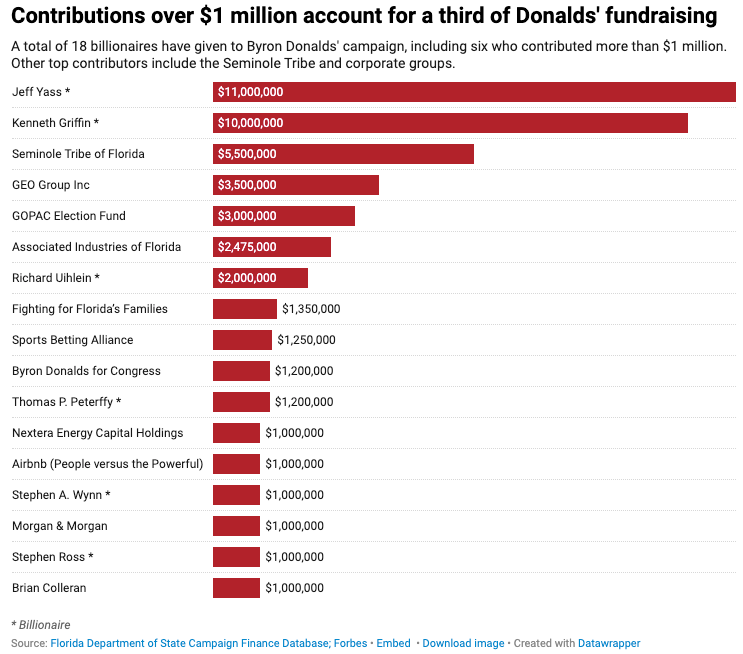
The Seminole Tribe, Donalds’ third-largest donor, has a monopoly over sports betting in Florida. On Oct. 8, the tribe filed a lawsuit against DraftKings, alleging that the platform is bypassing state law by offering sports betting through its prediction market products.
DraftKings and its allies are also contributing to Donalds. The Sports Betting Alliance, which includes industry leaders DraftKings and Fanduel, gave nearly $1.3 million, while the two betting platforms each gave $500,000.
Donalds’ fourth-largest donor is GEO Group, a private prison company that operates 95 facilities, including several immigration detention centers. Its headquarters and four of its prisons are located in Florida.
The AI industry has also heavily supported Donalds, both through direct contributions and independent expenditures.
Leading the Future, a pro-AI super PAC, donated $3 million to American Mission Florida, a super PAC that has spent at least $2 million on ad spots for Donalds.
Public First Action, an AI-safety group with an arm dedicated to promoting conservative candidates, has also spent on ads for Donalds. The ads are part of a $15 million buy for candidates across the country, though the amount spent specifically on Donalds is not specified.
And NextEra Energy, the parent company of Florida energy providers looking to construct data centers in the state, has edged into Donalds’ top donors with a contribution of $1 million.
Donalds has said he would prevent taxpayer dollars from going to data center construction but also told voters in August “there ain’t no bans coming.” Jolly has said he would place a moratorium on data center construction and attacked Donalds for his support of their construction.
Some of Donalds’ largest contributions have come from committees funded entirely by one donor, such as CFG Action and the People Versus the Powerful PAC. The latter PAC, which has given $1 million to Donalds, is funded by Airbnb.
Jolly’s campaign attracts fewer seven-figure donors
Jolly has raised $11.5 million through his individual candidate committee. That total includes $2.8 million in distributions from the state’s public campaign financing program, more than double what Donalds has received from the program.
Jolly’s affiliated PAC, Florida 2026, has received contributions from at least five billionaires – Donald Sussman, Henry Laufer, Mike Fernandez, Deborah Simon and Illinois Gov. J.B. Pritzker (D). Several of his other top donors are millionaire Democratic megadonors.
“I’m happy to meet with anybody that represents interests across the state of Florida, but they’re not going to buy their way in,” Jolly said at a September press conference. “So we have turned down a number of offers of contributions, financial contributions from interests and industries within the state.”
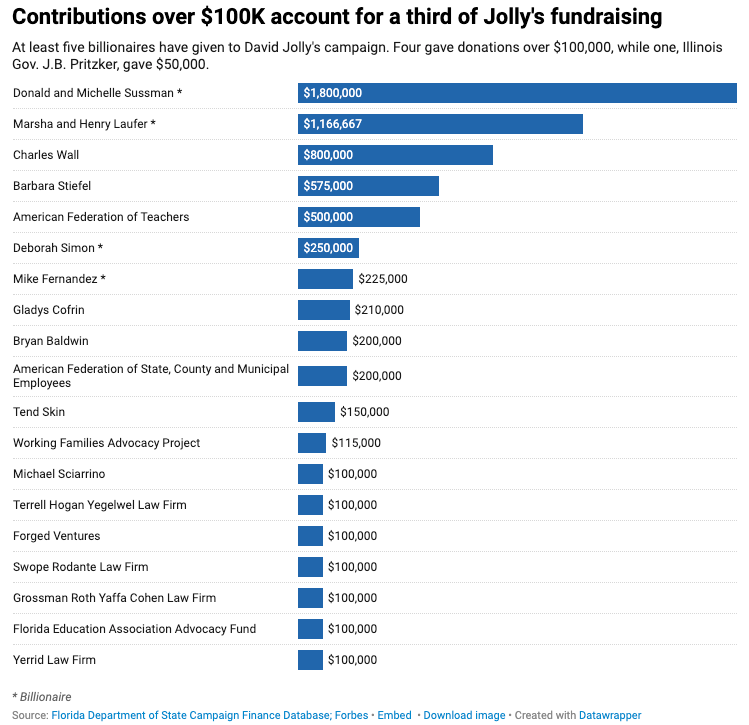
There are only 13 political committees in Jolly’s top 500 donors, according to an OpenSecrets analysis of campaign finance records. Jolly has not received support from major Democratic PACs and nonprofits funding other gubernatorial campaigns, such as the Democratic Governors’ Association and Kentucky Gov. Andy Beshear’s In This Together super PAC.
In late September, Jolly implored the national Democratic Party “to come into Florida and start spending money.”
In final weeks, cash gap sits at $33.3 million
Despite a relatively narrow gap between their campaign accounts, Donalds’ PAC has continued to pull in millions – and he’s taken full advantage of his available cash. As of Oct. 20, he had spent over $110 million on his campaign, while Jolly had spent $17 million.
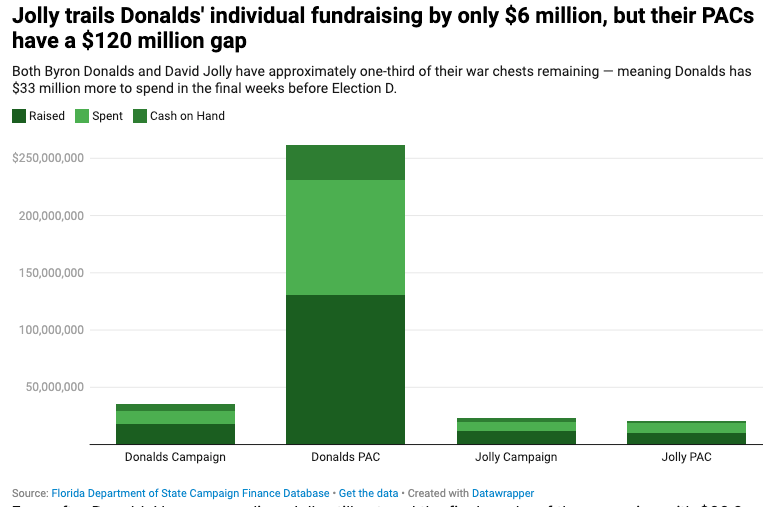
Even after Donalds’ heavy spending, Jolly still entered the final weeks of the campaign with $33.3 million less to spend.
As Donalds’ war chest has grown, big money donors have only become more inclined to donate to him, Jewett said.
“The moneyed interests tend to give to the favorite, because the idea is, if you’re giving money, you’re trying to get access and influence,” Jewett said. “And you don’t want to have access and influence to the loser, have access and influence to the winner.”

OpenSecrets.org is nonpartisan, independent, and nonprofit, with a mission to serve as the trusted authority on money in American politics by providing comprehensive and reliable data, analysis, and tools for policymakers, storytellers, and citizens. This story was republished with their permission.
Where Donalds’ personal wealth comes from
In addition to the millions pouring into the Donalds’ campaign from special interests, there’s his personal wealth.
As the Tampa Bay Times and Miami Herald reported:
Five state-funded charter schools have paid more than $30 million over the last four years to two private companies run by Erika Donalds — whose husband is Florida’s Republican candidate for governor — according to a Times/Herald analysis of tax filings and state audits.
Now, one of those companies is set to receive its largest payout yet. Her virtual reality curriculum company OptimaEd LLC is on track to charge the online school Optima Classical Academy $15.7 million in service fees for the 2026 and 2027 school year, budget documents show.
Once the taxpayer money lands in the coffers of Donalds’ businesses, how it’s used and how much executives are paid is not publicly reported. But Byron Donalds’ federal financial disclosures show that the majority of the couple’s collective wealth comes from his wife’s companies — and the public dollars they rely on.
If he wins, for the first time, Florida could have a leader whose family wealth is tied to the flow of taxpayer funds to the private charter school management industry. That means, as governor, decisions he makes about public education funding could have a direct impact on his family’s bottom line.

Thanks for your support
Since launching this newsletter a year ago, thousands of subscribers have joined the Tropic Press community, making it one of the fastest-growing publications of its kind.
Our goal is to reach as many voters as possible to increase engagement in the political process and, hopefully, raise interest in voting this coming November. We do that through original reporting and by sharing stories like these today.
If you are encountering this newsletter for the first time, please consider subscribing. If you are already a subscriber, consider upgrading your subscription to help this work continue.
Regardless, every person you share this with is one more potential vote for change.
Please share — and restack— and help us make Florida — and America — better for all of us.
Thanks.
J.C. Bruce
