

By J.C. Bruce
Florida is the epicenter of an outbreak of dengue fever that so far has sickened 624 people and is frequently described in news stories as “the largest in decades.”
Which raises the inevitable question: You mean it’s been worse before?
And the answer, sadly, is: Yes.
One example: In 1934, a dengue outbreak started in Miami and spread northward through Florida, infecting about 15,000 people in Dade County alone.
And dengue is hardly the only mosquito-borne disease that has plagued the state and nation. Yellow fever, for instance, over the years has killed between 100,000 and 150,000 Americans. Malaria, another 10,000. West Nile virus 3,000.
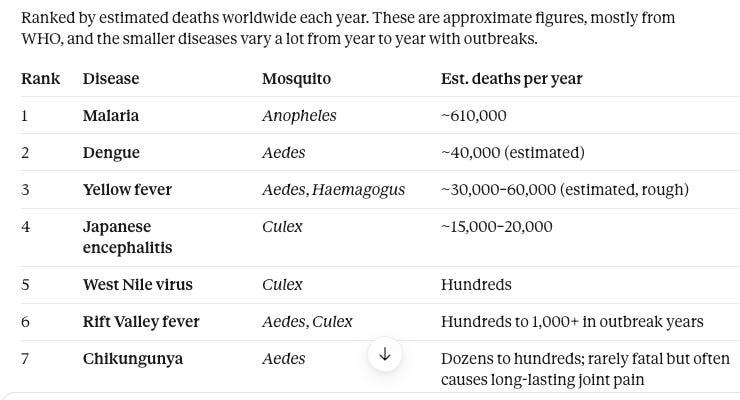
Worldwide, the number of annual fatalities from mosquito-borne diseases is staggering:
Dengue is a particularly nasty disease, sometimes called breakbone fever because of the agony it causes in the back, joints, and limbs, although it doesn’t actually break bones. It can, however, in the worst cases, cause severe abdominal pain, vomiting, bleeding, fatigue, and trouble breathing. There is no vaccine available in the U.S.
Florida recorded 100 new locally acquired dengue fever cases during the first week of November this year, bringing the state’s 2026 total to 624, according to the Florida Department of Health. The state’s previous high in recent memory was 199 cases in 2023, and 62 cases in 2025.
The outbreak, which began this summer, has been centered in the Tampa Bay area. As of earlier this month, Hillsborough County had 468 cases, and Pinellas had 109. The virus has killed at least one person.
However, WUSF reported that the true number of infections is probably higher. Symptoms usually don’t appear until about two weeks after an infected mosquito bites someone, so the counts likely miss some cases.
Why Tampa Bay
Unlike some other Florida counties, the Tampa area wasn’t set up to fight dengue, WUSF reported.
Dengue has been very active worldwide, so more infected travelers are arriving in Florida. Local mosquitoes then bite them and spread the virus, said Eva Buckner, an insect scientist at the University of Florida.
The weather also played a part. A long drought earlier this year let drought-resistant mosquito eggs pile up, and when rain returned, the eggs hatched at once, Buckner told WUSF.
That rain fell almost daily in August and kept outdoor containers filled with water. As a result, the county’s mosquito population jumped that month, Peter Jiang, Hillsborough County’s mosquito control chief, said.
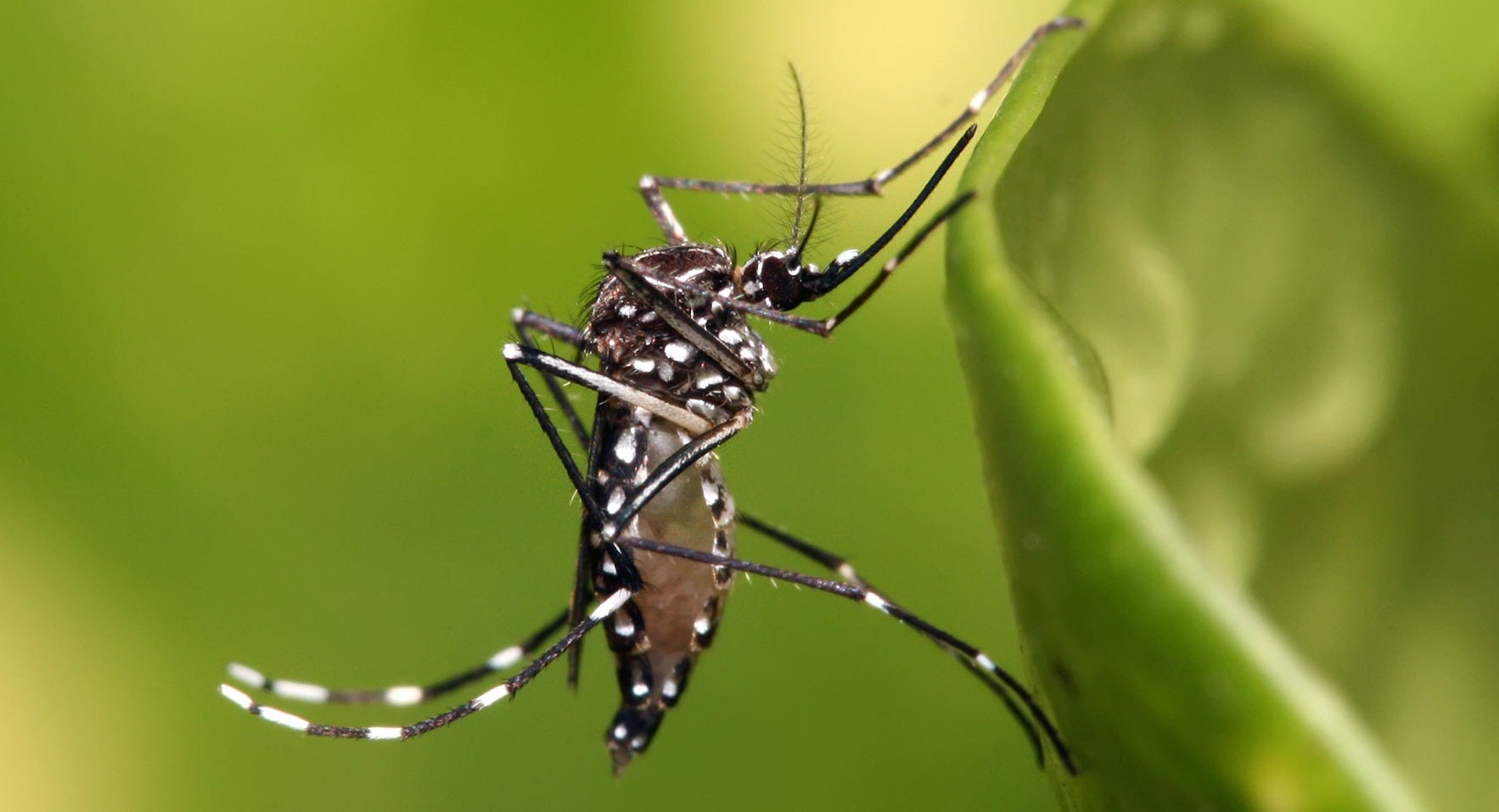
The mosquito that carries dengue, Aedes aegypti, prefers cities to swamps. It lays its eggs in flowerpots, watering cans, and other containers near homes.
Why now?
So, why has it been so long since we’ve had an outbreak of this magnitude?
Mosquito control initiatives, including the widespread use of pesticides, are a major factor. Also, improved sanitation processes (including eliminating open sewers), vaccines (for yellow fever, for instance), air conditioning, window and door screens, and insect repellents have helped separate humans from mosquitoes.
However, warmer weather is making temperatures that are ideal for spreading dengue more common, Stanford University researcher Erin Mordecai told WUSF.
In a study published last year, Mordecai and her colleagues estimated that about 18% of dengue cases worldwide could be traced to warming that had already happened by 1995–2014.
What’s next
With winter coming, will we get a break from all this?
Depends.
Forecasts for a strong El Niño this winter worry mosquito control officials. “If we do have an excessively wet winter, that is going to continue to allow mosquito production,” Adriane Rogers, director of the Pasco County Mosquito Control District, said.
What can we do?
Common advice found online includes:
1. Use EPA-Registered Insect Repellents
2. Wear Protective Clothing. Wear loose-fitting, long-sleeved shirts, long pants, and closed-toe shoes, and choose light-colored clothing, as dark colors tend to attract mosquitoes.
3. Protect Your Home and Environment. Make sure window and door screens have no tears or gaps, and use air conditioning. Empty, scrub, cover, or throw out weekly containers that hold water (such as flowerpots, birdbaths, gutters, pet bowls, and discarded tires).
Special thanks to WUSF’s coverage of the outbreak. Check out these stories for additional information.
How Florida became the epicenter of localized U.S. dengue cases and what role climate played
Florida’s dengue outbreak is now the largest in the continental US in decades

A little help, please …
Beyond subscribing, one of the most helpful things you can do as a member of the Tropic Press community is to share this work with others. You can do that by hitting the SHARE button below (or simply forwarding this email) and also by hitting the RESTACK icon at the bottom of the post. It’s a lot smaller, but it looks like this:

Reposting sends these newsletters to other readers on the Substack network. And the more people we reach, the more effective we can be at changing the trajectory of our state and nation.

With the passing of Amendment 3 I wonder if the funds to eradicate mosquitos will be available in the future?
You wrote, "There is no vaccine." Actually , there are two vaccines that are available in other countries, but not the United States. For more information, see:
https://www.who.int/news-room/questions-and-answers/item/dengue-vaccines
and
https://en.wikipedia.org/wiki/Dengue_vaccine