

Florida lawmakers return to Tallahassee next week for swearing-in ceremonies, and the Legislature will look a lot different once they’re done.
Democrats just flipped 16 seats in the Florida House of Representatives and are likely to add a 17th once a recount is completed. Republicans also turned one the other way, which means Democrats should come away from the 2026 elections with a net gain of 16 seats.
The result is a 70-50 Republican majority in the 120-member state House — a divide of just 10 seats and the slimmest GOP edge in 30 years.
Ten Republican incumbents were swept away by last week’s “blue tsunami,” which crashed hard into Florida even though it didn’t quite reach the top of the ticket. Among them: Rep. Meg “MAGA Meg” Weinberger (R-Palm Beach Gardens), President Donald Trump’s favorite Florida legislator, and Rep. Danny Alvarez (R-Riverview), who was defeated by a “proud Democratic Socialist.”
Every single GOP House member in metro Orlando lost their seat.
But what may be even more surprising is how close Democrats came to flipping the entire chamber.
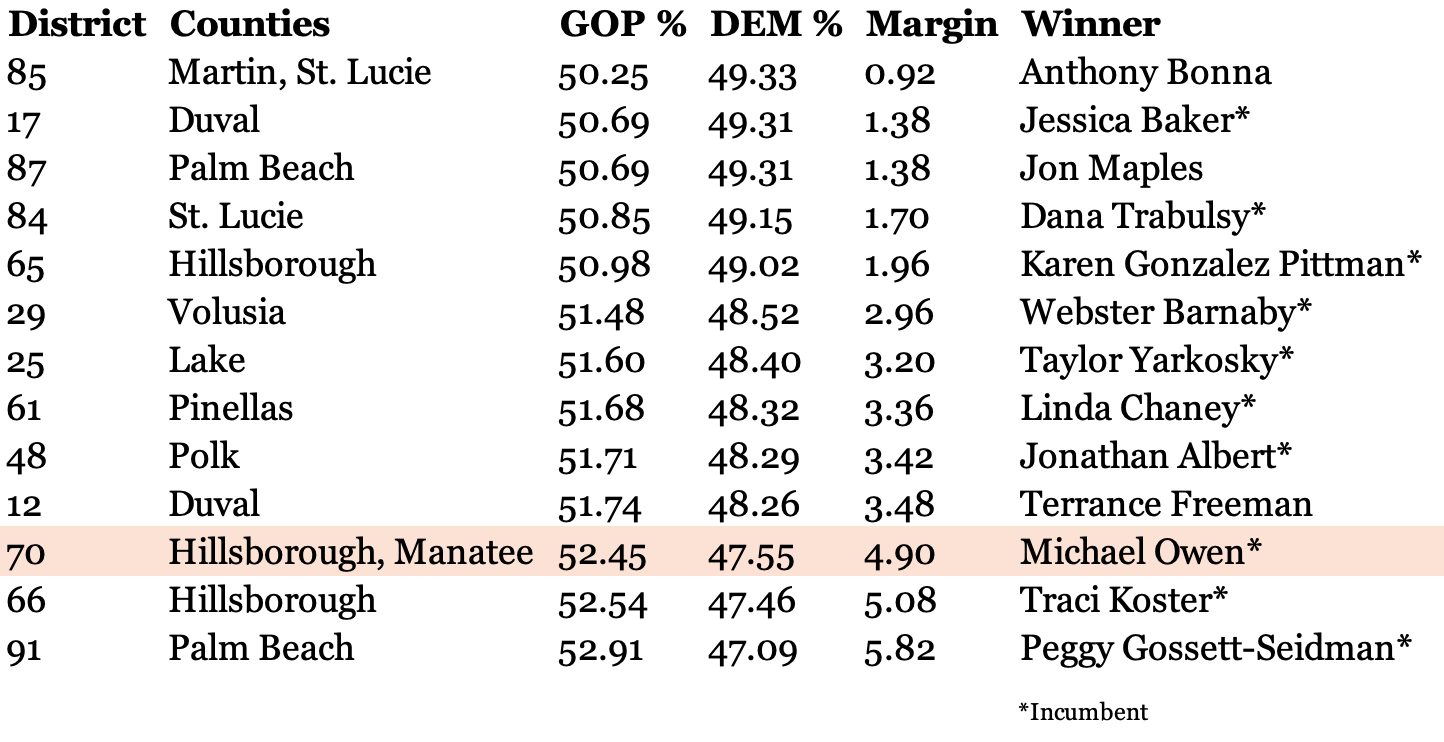
The 70 seats that Republicans took last week include five won by less than two percentage points and another five won by less than four. The GOP incumbent won what would have been the tipping point seat — House District 70 in Tampa Bay — by less than five points.
Now, to be clear, five points is a lot. If Democrats had done five points better across Florida last week, Angie Nixon would be on her way to Washington, David Jolly would be sending back Mori Hosseini’s golf simulator, and José Javier Rodriguez would be drafting Hope Florida subpoenas.
But it also offers a sense of just how close a blue wave came to breaking the Republican gerrymander in the Florida House — as it did in other state houses like North Carolina, Texas and Wisconsin.
It was a similar story in the Florida Senate. Democrats only captured one new seat in the Legislature’s upper chamber: Senate District 10 in Orlando, where Democratic challenger John Lowndes rolled Republican incumbent Jason Brodeur by nearly 12 points.
But Democrats also successfully defended Senate District 14 in Tampa, where Democratic Sen. Brian Nathan defeated former GOP state Rep. Josie Tomkow by nearly five points in a rematch of a March special election that Nathan had won by less than one point.
That was enough to end the Republican supermajority in the 40-member Senate, too, where there will now be 26 Republicans, 13 Democrats and 1 one independent senator who won his election as a Democrat. The 40th seat — which had been held by Lt. Gov.-elect Bryan Avila (R-Miami Springs) — will have to be filled via a special election.
But Democrats also came within two points of flipping four more Senate seats — two in Miami, one in St. Petersburg, and one on the Polk County side of Walt Disney World, a region that may be rapidly turning blue along with the rest of metro Orlando.

Looking ahead, the Senate map may be smaller in 2028.
There are at least two obvious Democratic targets: Senate District 37 in south Florida, currently held by term-limited Sen. Jason Pizzo (NPA-Hollywood), and Senate District 3 in north Florida, currently held by Sen. Corey Simon (R-Tallahassee).
But beyond that, Democrats would probably need to continue making big gains in places like Tampa Bay (Senate District 23, held by term-limited Sen. Danny Burgess) or along the Treasure Coast (Senate District 31, held by term-limited Sen. Gayle Harrell) to make any further pickups.
But, of course, every seat in the state House will be on the ballot again.
A key question is whether 2026 was a once-in-generation event akin to the post-Watergate elections or whether it was the start of an extended cycle similar to the end of the George W. Bush presidency and the rise of Barack Obama.
Recall that eight years ago — during the last mid-term election with Donald Trump in the White House — Democrats won 47 seats in the state House. Just a few years later, they had sunk to a record-low 33.
But if the national environment in 2028 is anything like it was this year — and the selection of Stephen Miller as the new White House chief of staff certainly suggests it could be — then, as shocking as this may seem, Democrats may actually have a path to a state House majority in Florida.

This report by Jason Garcia is from Seeking Rents, a newsletter and podcast devoted to independent journalism about Florida politics, with an emphasis on how big businesses and other special interests influence public policy in the state.
Seeking Rents is free, but you can support Jason Garcia’s work by becoming a paid subscriber and/or by making a one-time donation. The name, Seeking Rents, comes from a term meaning the act or process of exploiting the political process or manipulating the economic environment to increase one’s revenue or profits.
To subscribe to Jason Garcia’s work, click here:

A little help, please …
Beyond subscribing, one of the most helpful things you can do as a member of the Tropic Press community is to share this work with others. You can do that by hitting the SHARE button below (or simply forwarding this email) and also by hitting the RESTACK icon at the bottom of the post. It’s a lot smaller, but it looks like this:

Reposting sends these newsletters to other readers on the Substack network. And the more people we reach, the more effective we can be at changing the trajectory of our state and nation.
