

By Jeff Brandes
Everyone is talking about property taxes. Almost nobody is talking about power.
That’s strange because power, not taxes, is what this debate is really about. The sales pitch is simple: property taxes are unpopular, homeowners are angry, government has grown, and cutting tax bills will provide relief. Who doesn’t like that? But there is a difference between cutting taxes and changing who controls government. Florida is not debating a tax cut. Florida is debating a fundamental redesign of how local government is financed.
For more than half a century, Florida has embraced home rule. The idea was simple: Local communities should make local decisions. If a city council spends too much, voters can replace it. If a county commission raises taxes, voters can replace it. The people making spending decisions are accountable to the people paying the bills. That system is imperfect, but it is transparent. If your local government fails, you know exactly where to direct your frustration and exactly who to vote against.
Now imagine a different system. Imagine counties and cities that can no longer fund themselves. Imagine local officials traveling to Tallahassee not to seek a grant for a new project, but to keep deputies on patrol, firefighters in stations, and ambulances on the road. At that point, who is really running local government? The answer is not the county commission. The answer is not the city council.
The answer is whoever controls the money.
We use your personal data for interest-based advertising, as outlined in our Privacy Notice.
That is the part nobody wants to discuss. Property taxes are not simply a revenue source. They are the mechanism that allows local governments to govern themselves. Remove enough of that revenue and local governments do not disappear. They become dependent. And dependency changes behavior. A business dependent on one customer changes its behavior. A nonprofit dependent on one donor changes its behavior. A county dependent on Tallahassee changes its behavior. The money moves. The incentives move. The accountability moves. And eventually, the power moves.
There is an irony here that should give conservatives pause. A proposal intended to shrink government could ultimately centralize it. When counties and cities become financially dependent on Tallahassee, the governor effectively becomes the mayor of communities he was never elected to run. Imagine a future governor deciding which counties receive funding for deputies, which cities receive support for fire services, and which communities must wait. Local government becomes less local. Home rule becomes a slogan instead of a governing principle.
Supporters frame this debate as a battle between taxpayers and government. That is the wrong framework. The real question is whether Florida wants independent local governments or dependent local governments. Because independent local government means paying your own bills.
The numbers involved are staggering. Property taxes generate tens of billions of dollars each year for local governments. State economists have modeled scenarios creating roughly an $18.3 billion hole. Municipal governments receive approximately 43 percent of their general fund revenue from property taxes. Property taxes account for roughly 79 percent of municipal tax revenue. Those are not trimming-around-the-edges numbers. Those are rebuild-the-engine-while-the-plane-is-flying numbers. Yet much of the public discussion proceeds as though this is simply a tax cut. It isn’t. It is one of the largest transfers of financial responsibility in modern Florida history.
Maybe it works. Maybe local governments become dramatically more efficient. Maybe new revenue sources emerge. Maybe the state permanently assumes a larger role. But if that’s the plan, let’s be honest enough to say so. What we should not do is pretend the consequences stop at the property tax bill.
State economists are already projecting structural deficits beginning in fiscal year 2027-28 and growing in the years that follow. If Florida itself is heading toward tighter budgets, is this really the moment to shift even greater responsibility for local government onto the state? Florida may be creating a future where local governments are increasingly dependent on a state government that is itself under growing fiscal pressure.
Then there are the people largely missing from this conversation. Nearly one-third of Floridians rent their homes. If local governments replace property taxes with higher fees, assessments, utility taxes, sales taxes, or state transfers, renters will still pay. Businesses will still pay. Consumers will still pay. The bill does not disappear. It changes addresses.
Milton Friedman often reminded people that government has no money of its own. Every dollar government spends comes from somebody else. That remains true today. The question is not whether Floridians will pay for local government. The question is how. And more importantly, who will decide.
That is the blast radius nobody is talking about.
Because once the dust settles, Floridians may discover they did not merely change a tax system. They changed the balance of power between local communities and the state itself. And unlike a tax bill, that is a change that will be far harder to reverse.
Jeff Brandes is President of the Florida Policy Project, a nonpartisan public policy research organization focused on Florida’s biggest challenges, including affordability, housing, transportation, and insurance. He served for 12 years in the Florida Legislature, including service in both the Florida House and Senate.
This article originally appeared in Florida Trident and is republished here with their permission. The Trident is an investigative news outlet focusing on government accountability and transparency across Florida. It is a publication of the Florida Center for Government Accountability. You can support this work by donating here:
Please share this post
Our democracy as we’ve known it for 250 years is at risk. To save it, we will need a groundswell of support from voters in the coming midterm election.
The purpose of this newsletter—and the accompanying Tropic Press website—is to encourage that engagement through original reporting and commentary and shared stories such as today’s article first published in Florida Trident.
Currently, Tropic Press is reaching more than 700,000 subscribers in Florida and elsewhere, which is great, but there are literally millions of Florida Democrats and independents we are not reaching yet.
You can help spread the word.
Please like this post. Comment if you are so inclined. But, please, also take a moment to share it with people you know.
With mid-term elections on the horizon, the more people we reach, the more effective we can be in helping turn our state and this country around. You can play a vital role in that effort.
Thanks.
J.C. Bruce
Today’s sponsor: The Strange Files
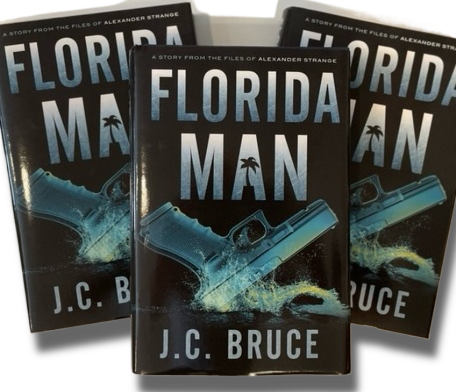
Alexander Strange wants to get to Florida in the worst way. So, he arrives in a coffin. Chilling in its own right but made more so by the prediction of a New Orleans soothsayer that he soon will face death. Little does he know how true that will be. But he’ll find out soon enough at the Devil’s Millhopper.
Book Two of the Strange Files series takes our favorite weird news reporter on a bizarre scavenger hunt all over the Gunshine State. Join him in his journey here:
This is the crux of the issue. And it pushes us all further into a situation where whatever party is in power consolidates even more power, forcing everyone to live by a set of rules and values they might not agree with. It allows the state to "punish" areas by withholding funds if they don't go along with a mandate. And it will create even more income inequality, as wealthier areas which can donate money to the powers that be will get the lion's share of the communal pot.
Great article that captures the real issue. You know it can't be a good thing for the residents of Florida when a state-sponsored website explains their version of the pros and cons. DeSantis is leaving and wants to believe all Floridians will remember their savior who removed property taxes. He's not going to be here to deal with the backlash. I'm regularly responding to people on Nextdoor who don't understand what their property taxes are used for. If this is passed and it doesn't work, what will Floridians do then? Are each of us going to do our own law enforcement, firefighting, and hauling our trash to the dump?