
Every vote counts: It's why Florida Democrats are scrambling to find legislative candidates
News and commentary for Floridians who care about the future of our state
There are 140 seats in the Florida House and Senate up for grabs in the fall midterm election.
Currently, the vast majority are held by Republicans.
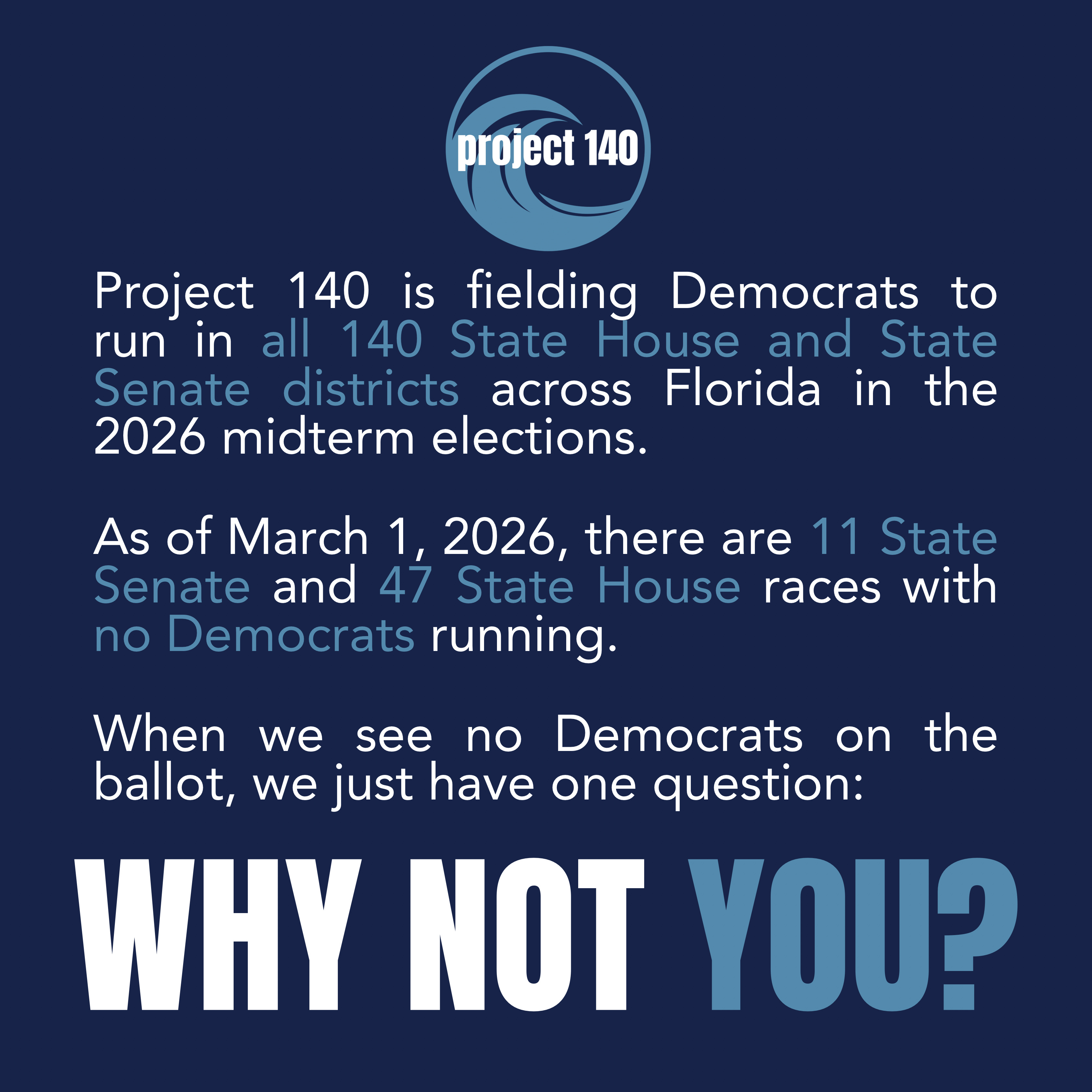
That won’t change if Democrats don’t run for office, and as of March 1, there were 11 Senate seats and 47 House seats with no Democratic candidates. Finding candidates for those races isn’t just the responsibility of the party. Volunteer groups are jumping in to help.
Enter Project 140, an initiative of a registered Florida political committee known as Blue Florida.
The committee, led by Naples Democratic activist Margie Stein, wants to ensure that by the qualifying deadline in June, most, if not all, of those seats have Democratic candidates running for those offices.
And it’s more than just those legislative seats at play.
Having local candidates on ballots means more volunteers on the street registering new voters, passing out literature, and encouraging voters to show up on election day. Even in legislative districts that are heavily gerrymandered in favor of Republicans, those Democratic votes can roll up into the totals for statewide candidates, such as this year’s races for governor and U.S. Senate.
“We need to get out every voter we can in November to vote for Democrats,” Stein says. “People are more likely to vote when they have someone to vote for.”
Which might seem self-evident, but even if having local candidates only raises Democratic vote totals marginally, that can make a huge difference.
Consider the year 2000, when Florida was the epicenter of national controversy. The election between Vice President Al Gore and Gov. George W. Bush of Texas was so close that it ended up in the Supreme Court. By the time the court stopped the recount of ballots and Al Gore conceded the election, Bush was ahead by only 537 votes in Florida.
We’ve all heard the expression that every vote counts. Well, this is Exhibit A. Those 537 votes won Bush the presidency.
What would our world be like today were that not so? No misguided war in Iraq haunting us? More action on climate change? Economic stability? That margin was fateful.
While this razor-thin presidential election was taking place, Florida, at that time, had 23 congressional districts. In seven of them, though, Republicans ran unopposed because there were no Democratic candidates.
In eight out of the 20 state Senate districts, no Democrats were running either, and in 30 of the 120 state House districts, Republicans were also unopposed by Democratic candidates.
“If you look at any of the data about what happens when you have candidates running, knocking on doors, inspiring voters to turn out … you know that turnout goes up,” said David Pepper, former chairman of the Ohio Democratic Party, often quoted by Blue Florida organizers.
Theoretically, Gore might have won in 2000 if Democrats had simply fielded candidates in those unopposed races. It would have been enough even if the difference was only one additional vote for every 10 precincts in the state (there are about 5,600 precincts statewide).
There’s no way to actually prove that, of course. Every election is different. Republicans facing opposing candidates also would have been motivated to work harder to turn out more voters, so it’s impossible to know.
But Blue Florida’s argument is this:
“In this year of years, it is all the more important that we get everybody out to vote because we have the possibility to elect a Democratic senator and a Democratic governor,” Stein says. “Whether a local statehouse seat wins or loses is not the point. If we pick up margins, those votes—even if we lose (locally)—they will help the candidates at the top of the ticket.”
With so many Republicans riding President Donald Trump’s coattails, and with Trump’s popularity underwater in public opinion polls, some offices now with Republican incumbents might be up for grabs—both in the state Legislature and Congress. That’s the theory, anyway.
“Anything within 10 points is winnable,” Stein says. “Some people say it’s 14 points, so I’ll take 10.”
A recent poll by the University of North Florida Public Opinion Research Lab showed that in hypothetical matchups in both the races for governor and U.S. Senate, the leading Democratic candidates were well within those 10-point margins.
Still, the numbers working against Democrats are daunting. I’ve published this before, but here’s a look at voter registration in the state:
Pretty clearly, any statewide Democrats running in the midterms are going to need some help from disaffected Republicans, unaffiliated voters, and an energized Democratic turnout.
At a press conference late last year, state Democratic Party chair Nikki Fried put it this way:
"There's no magic bullet. It is just about sweat equity, getting good candidates, and finding solutions to the problems that are facing the people of our state."
While the first task is, indeed, to recruit candidates, there’s a lot more to it, Stein says.
“We are here not only to find candidates, but we help train them on the basics of running for office, provide a solid structure for running a well-organized and scrappy grassroots campaign. Project 140 (gives candidates) the tools to run a credible campaign that increases the base of support for Democrats…”
Stein helped launch Blue Florida in 2020. The goal then, as now, is “to promote fair elections and encourage the participation of as many residents in Florida in the election process as possible. Handing the decisions being made to state officials in Florida without elected contests is just not a good idea.”
For more information on this initiative, check out Blue Florida’s website here:
Related Story:
Florida Democratic candidates for governor and Senate closing in on likely Republicans
Websites for leading Democrats for Senate and governor:
Onward thru the fog
It’s easy to feel overwhelmed if you are a rational person living in the Free State of Florida, but there are plenty of smart, reasonable people just like you here. The purpose of this newsletter and the Tropic Press website is to provide a source of news and commentary that shines a light through this irrational fog. That includes both original reporting, like today’s report, and shared stories from other sources.
Thank you for your support as a subscriber. It is invaluable. This is especially so for those of you who have chosen to upgrade to paid subscriptions. Your contributions are making this possible.
J.C. Bruce
Sharing is caring
As this newsletter was written, Tropic Press was reaching more than 750,000 subscribers in Florida and elsewhere. With mid-term elections on the horizon, the more people we reach, the more effective we can be in helping turn this country around. You can play a vital role in that effort by sharing this newsletter with friends. If you are reading this as an email, simply forward it. Or you can use the link below. Thanks.
More online
Thank you for reading the Tropic Press newsletter. You also have access to the Tropic Press website for additional and previous posts, an archive of posts from our advice columnist, Miss Mingo, and occasional guest commentaries.
Get Your Mingo Merch
The official Tropic Press Store is now open and ready for business. You can order your very own Miss Mingo tee shirts and coffee mugs online. All sales are final. Check out the store here:


Thanks for highlighting this issue. I donated to the organization! 💙🌊
Informative article. We must keep trying and I’m glad there’s an organization doing something about it.