
Florida independent voters may hold the key to the governor's race and the outcome of gerrymandering
News and views for discerning Floridians and other Americans
Florida’s independent voters—those unaligned with either the Democratic or Republican parties—may hold the key to the 2026 midterm elections in Florida.
The question of who Florida’s NPAs will vote for is at the core of two stories making headlines this morning. (NPA is shorthand for No Party Affiliation, a clunky acronym used to classify the state’s 3.4 million independent registered voters.)
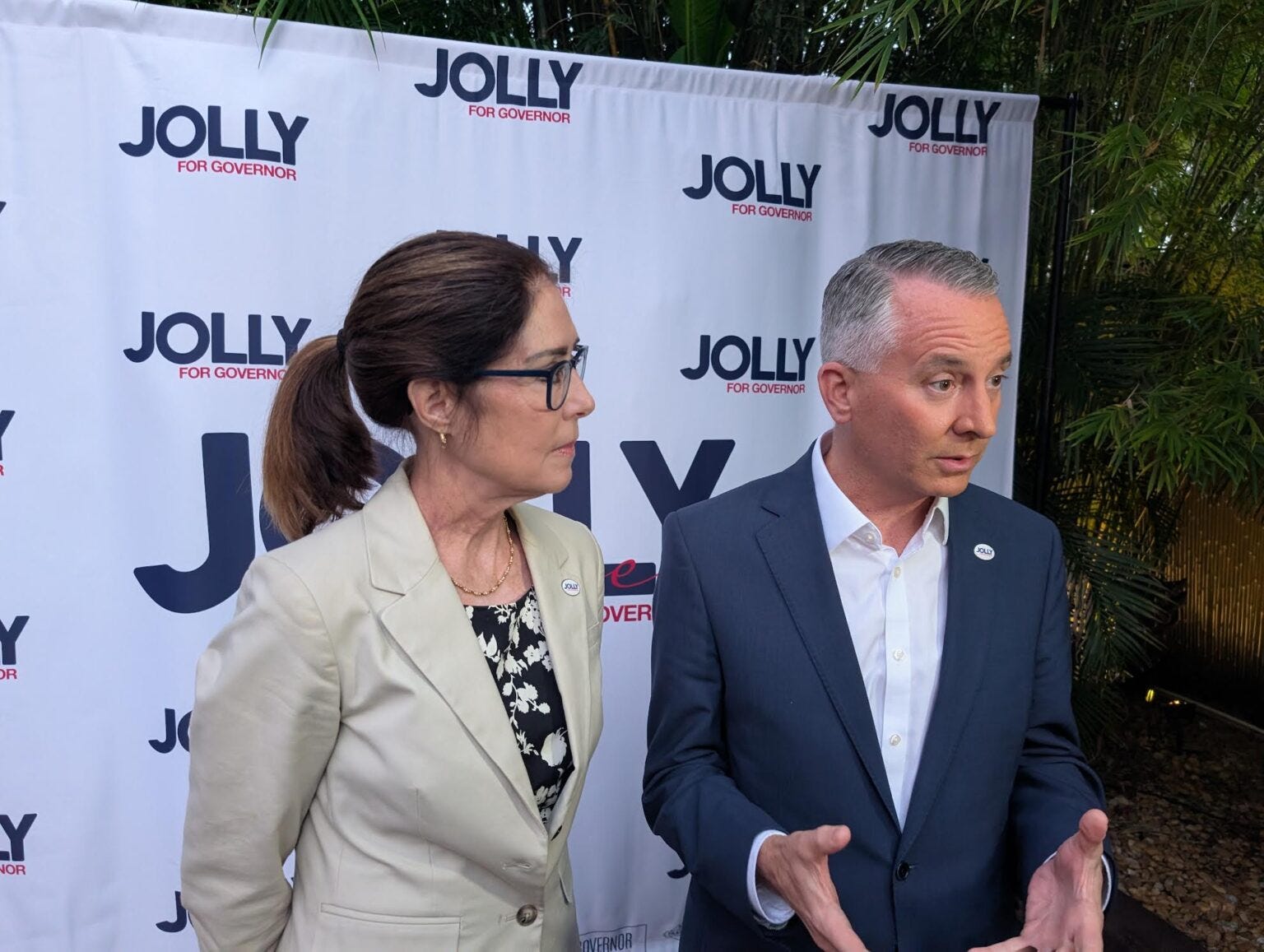
One story centers on the possibility that former Florida U.S. Rep. Gwen Graham (and the daughter of former Florida Gov. Bob Graham) may run for lieutenant governor on Republican-turned-Democrat David Jolly’s ticket in the governor’s race.
The other story focuses on efforts by Republicans in the Florida Legislature to further gerrymander the state’s congressional districts to favor the G.O.P.
In both stories, how independents are likely to react is central to predicting the outcomes of those strategies.
A Jolly-Graham ticket?
Florida Phoenix reporter Mitch Perry covered an appearance by Graham and Jolly in St. Petersburg this weekend, and in an interview, Graham said it was a “no brainer” that she would support Jolly’s candidacy for the Democratic Party’s nomination.
“I would not be standing here if I didn’t know he could win,” she said. “This election is too important. We’ve got to have a candidate in November who can win so we can start reversing the damage that has been done to the state that I love and my father loved, and David can win. So, I’m going to do whatever I can to help him do that.”
The question that arises: Would Graham on Jolly’s ticket help him win in November—assuming he emerges as the Democratic nominee? First, he will square off in the August primary election against Mayor Jerry Demings of Orange County. Which is likely why Jolly has said he’ll name his running mate before the primary.
“She would bring in more conservative Democrats, and independents would love her,” Angela Birdsong, president of the Hillsborough County Democratic Black Caucus, said of Graham’s addition to the ticket.
When asked if that might prove too moderate, Birdsong said:
“… I think that we’re going to have to run some vanilla candidates for a while.”
Polling data shows that independents, drawn largely from the disaffected ranks of Democrats and Republicans, do tend to be less polarized in their political views.
A recent Gallup survey shows:
Independents are a growing cohort of voters nationally—more Americans identify as independents (40 percent) than as Democrats (29 percent) or Republicans (30 percent). In Florida, NPAs comprise about 26 percent of registered voters.
Independents overwhelmingly identify as “moderate” and state they agree with both major parties on certain issues. For example, independents tend to trust Democrats more on abortion, healthcare, and climate change, while they prefer Republicans on the economy, gun rights, and immigration.
Despite their numbers, millions of independents are excluded from primary elections.
On that last point, Ballotpedia notes that Florida is among 13 states in which both major political parties won’t allow independents to vote in their primary elections.
Which means the influence of independent voters will not be felt until the general election in November, as they will be excluded from voting in the August primary elections.
As I noted in my newsletter yesterday, however, there is a move afoot that could change that calculation.
A growing number of both independents and Democrats want the Democratic primary election to be opened to independent voters.
That can only happen if state law is changed—something that would require the unlikely cooperation of the Republican-dominated legislature—or as a result of legal action, which the Democratic Party could force.
So far, there has been no apparent movement on that.
About gerrymandering
A Florida House subcommittee charged with redrawing the state’s congressional district maps met briefly last week and is scheduled to reconvene on Wednesday.
At the urging of President Donald Trump, state Republicans will try to figure out how to squeeze more Republican-safe congressional districts out of an already heavily gerrymandered map.
It may not be possible.
Florida has 28 representatives in the U.S. House of Representatives, and currently, 20 of those seats are held by Republicans. Any efforts to push more G.O.P. voters into current Democratic districts would, by definition, dilute those safe Republican districts as their voters are moved out.
As the Washington Post noted today:
Redistricting is traditionally done once a decade based on the U.S. Census and population shifts in each state. But states redistricting ahead of the 2026 midterms are doing so without updated census data and, in some cases, Republicans are using the results of the 2024 presidential election — one that was markedly good for Republicans and in which Trump himself was on the ballot — to cut up their maps for partisan gain. Worried Republicans say basing redistricting on the 2024 election is a sizable leap, both because Trump’s coalition has not shown a willingness to show up when he isn’t on the ballot and polls show Trump is hemorrhaging support from key groups in his unique coalition.
Among those abandoning Trump are Hispanic voters, who were key to Trump’s Florida victory, and moderate Republicans frustrated with his economic policies that are driving up the cost of living.
Many of those voters are likely to be aligned with independent voters feeling similar frustrations, meaning that efforts to redraw congressional districts in the state based on the previous election’s results may be critically flawed, and the effort could backfire.
Related:
How much sense would a David Jolly-Gwen Graham ticket make for governor?
Should Florida’s primary elections be open to everyone, not just political party members?
Onward Thru the Fog
Your weekly guide through the perilous mists of time—at least for the next seven days—drawn from J.C. Bruce’s Essential News column that appears in Florida Weekly.
Today. Pretend to be a Time Traveler Day. This is a great way to make new friends. Pick out a stranger at the mall, for instance, and walk up to them and say something like: “Hi, I’m from the year 2525, and man is still alive. My flux capacitor is out of fuel. Can I borrow some hydrogen from you?” You’ll be amazed at what happens.
December 9. Today is Christmas Card Day, honoring the invention of the Christmas card in 1843 by Henry Cole in England, who was sick and tired of writing individual letters to his friends. For this, he was knighted by Queen Victoria, who may (or may not) have been sick of writing Christmas letters too.
If you are among those sending cards this year, you can forward them through the town of Christmas, Florida, where they will be officially stamped by the Post Office as coming from “Christmas.”
December 10. Dewey Decimal System Day, honoring Melvil Dewey, the inventor of the library cataloging system. Why Americans have no problem using the Dewey Decimal System but can’t figure out the Metric System is a mystery.
December 11. Today is International Mountain Day. It was on this day 4.2 billion years ago that the first mountain was formed on Earth.
December 12. Don’t Be Gullible Day. I think this refers to my previous item.
December 13. This is the start of the penultimate Christmas shopping weekend, so if you haven’t begun your annual buying binge, this weekend’s your second-to-last chance to rack up some serious credit card debt.
December 14. There is more than one religious tradition celebrated this month. Hanukkah begins this evening and lasts until Dec. 22. The eight-day Jewish Festival of Lights involves lighting the menorah, playing dreidel and eating delicious foods like latkes.
J.C. Bruce, journalist and author, is the founder of Tropic Press. He holds dual citizenship in the United States of America and his native Florida.
More online
Thank you for reading the Tropic Press newsletter. You also have access to the Tropic Press website for additional and previous posts, an archive of posts from our advice columnist, Miss Mingo, occasional guest commentaries, and information about The Strange Files series of mysterious adventures and other books.
Thanks to our sponsor
Today’s report is brought to you by Tropic Press Books, home of The Strange Files. You can find more information about these hilarious stories here:
It’s good to share
Tropic Press is a reader-supported publication. Here’s a big shout-out to all our loyal subscribers. Feel free to forward this email to your friends so they can enjoy it too. The more people we reach, the greater community of like-minded people we build. This is your chance to be part of all that. Thank you.


