
Should Florida's primary elections be open to everyone, not just political party members?
News and views for discerning Floridians and other Americans
If you’re a Florida citizen, your tax dollars pay for the state’s primary elections.
The results of those primaries determine the candidates who will appear on the November general election ballots.
But just because you help foot the bill through your tax dollars doesn’t guarantee you can vote in those crucial primary elections.
Why?
Because if you are among the millions of Florida residents who have chosen not to join a political party, you’re excluded.*
And Florida is one of only 13 states where both major political parties restrict primary election access like this.
Sounds like taxation without representation to me, but I’m curious how you feel about it, and at the end of this newsletter, I’ll be asking for your opinion.
The next statewide primary election will be August 18, 2026. At that time, voters—at least those allowed to vote—will select nominees for Florida governor, U.S. Senate, Congress, the Florida Legislature, and other state and local offices.
If you are among the 5.5 million registered Republicans, you get a say in who those candidates are.
If you are among the 4.1 million Democrats, you, too, will have the opportunity to cast a ballot in the primary election.
But if you are among the 3.4 million—and growing—voters who choose not to affiliate with a political party, you may be left out, even though you are paying for the election.
Tropic Press is a reader-supported publication. To receive new posts and support this work, consider becoming a free or paid subscriber.
In Florida, these independent voters are called NPAs, shorthand for No Party Affiliation. Among Florida’s NPAs, recent surveys show that 96 percent favor a change in state laws that would allow them to vote.
And, as it turns out, they have allies among rank-and-file Democrats—surveys show that 93 percent agree.
Leaders of the Florida Democratic Party say they are considering a proposal to open their primary elections to NPAs, an idea that seems to enjoy broad support, although the Florida Phoenix reported earlier this year that “the proposal was controversial among some Democrats, who feared it would divide a party that hasn’t seen a member of its ranks win a statewide race since 2018.”
We should probably pause here for a moment to reflect on that statistic: Democrats, who enjoyed a majority of registered voters in Florida until just a few years ago, have been edged out of statewide office for more than seven years. In fact, there hasn’t been a Democratic governor in Florida in the 21st century.
You might think that a political party in such dire straits might jump on a chance to open its ranks to more voters, especially since the idea is viewed so favorably. Clearly, Democrats have to change something if they want to win. But, so far, there has been no visible movement on this.
But even if party bigwigs were not divided on the idea, there’s another obstacle: As Democratic Party Chair Nikki Fried told Politico:
Opening primaries would either require the Legislature to change the law or require the party to sue the state on the grounds that Democrats have constitutional free association rights to decide who gets to participate in their primaries.
That’s the political calculation: From the Democrats’ perspective, would allowing NPAs to vote help or hinder?
But there’s a fundamental equity issue, too: If unaffiliated voters help pay for the election, why aren’t they allowed to vote?
One far-too-glib answer is that if NPAs want to vote, they can join a party. But why should anyone be coerced into that? Further, the counterargument is this: If political parties want to exclude registered voters from voting, they should pay for their primaries themselves and not stick everyone else with the tab.
In the United States, there is no unified system for how elections are managed, and, as noted earlier, Florida is among a minority of states that exclude voters in this manner.
Ballotpedia has catalogued the various schemes states use to organize their elections. Here’s a quick look, but for a more in-depth analysis, check out the links below.
Laws governing primary elections vary by state. In some states, primary types also vary by political party or office up for election.
In closed primaries only registered party members are allowed to vote. This is Florida’s system.
In semi-closed primaries, registered party members and unaffiliated voters are allowed to vote.
In open primaries, all voters are allowed to vote.
In top-two primaries, top-four primaries, and blanket primaries, all candidates are listed on the same ballot, regardless of partisan affiliation and voters may vote for candidates from more than one party.
How this plays out on a state-by-state basis can be a little confusing because political parties can have different rules within their own states.
As of September 2025, the Democratic Party used:[2]
Open primaries in 18 states
Closed primaries in 16 states
Semi-closed primaries in 13 states
The Republican Party used:[2]
Open primaries in 15 states
Closed primaries in 23 states
Semi-closed primaries in nine states
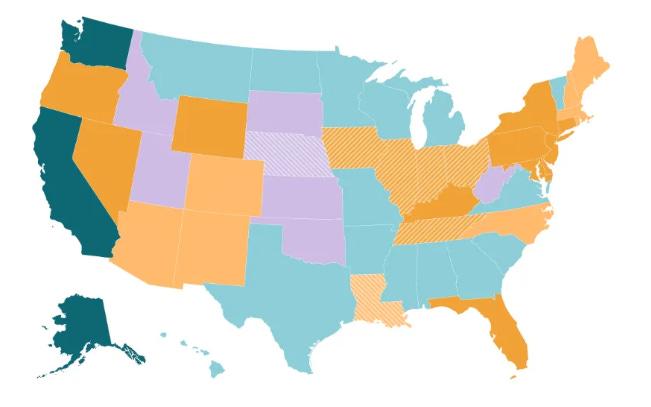
Here are some maps showing types of primaries:
You’ll note on the Closed Primaries map, above, that Florida is among 13 states in which both major political parties close their primaries, but there are other states (shaded more lightly) in which the parties are divided on that issue.
That’s precisely the proposal before Florida Democrats right now: Are they willing to change to a system where independent voters are allowed in?
I’ve included links below to more data if you are interested in exploring this on your own.
I realize I’ve allowed my own bias to show here, and I’ll confess that I do feel strongly that excluding millions of voters from participating in our elections is just plain wrong.
But I understand there can be more than one point of view on this. What’s your take? Share your thoughts with the Tropic Press community by joining in the Comments:
Related Stories and References:
Poll Shows Overwhelming Support for Opening Florida’s Primaries to 3.4M Independent Voters
Survey says Florida Dems and NPA voters support open primary elections
Ballotpedia: Primary election types by state
Florida Division of Elections Voter Registration by Party Affiliation
Florida Department of State Election Dates
*Primary election rules do have a few rare exceptions. If the primary ballot contains nonpartisan races (for example, certain judicial or school-board offices, local referenda, or other nonpartisan contests), then all registered voters may vote in those, regardless of their party registration. Also, if there’s a “universal primary contest” — that is, all the candidates for a particular office are from the same party and there will be no general-election opposition — then all registered voters, regardless of party affiliation, may vote in that contest.
While the article above deals primarily with NPAs, Democrats, and Republicans, there are a handful of minor parties in Florida, as well, comprising nearly half a million voters, as you can see from the chart above. They are:
Boricua Party (BPP)
Ecology Party of Florida (ECO)
Florida Forward Party (FFP)
Green Party of Florida (GRE)
MGTOW Party (MGT)
Reform Party (RFM)
You will note one of these parties is the Independent Party of Florida. This is why here in the Sunshine State we call independents (with a lowercase “i”) NPAs so as not to confuse them with the actual Independent Party.
J.C. Bruce, journalist and author, is the founder of Tropic Press. He holds dual citizenship in the United States of America and his native Florida.
ICYMI
Miss Mingo, our advice columnist, answers pressing questions from readers every Saturday in Tropic Press. In yesterday’s installment, she tackled this question, among others:
“Regarding the Epstein files...When a document is redacted, does it mean that it had already been dacted once and now it’s being dacted a second time, hence the word - REdacted? This mystery has been bothering me for quite some time. Can you clarify this?”
In case you missed it, you can find her answer on the Tropic Press website.
More online
Thank you for reading the Tropic Press newsletter. You also have access to the Tropic Press website for additional and previous posts, an archive of posts from our advice columnist, Miss Mingo, occasional guest commentaries, and information about The Strange Files series of mysterious adventures and other books.
Thanks to our sponsor
Today’s report is brought to you by Tropic Press Books, home of The Strange Files. You can find more information about these hilarious stories here:
It’s good to share
Tropic Press is a reader-supported publication. Here’s a big shout-out to all our loyal subscribers. Feel free to forward this email to your friends so they can enjoy it too. The more people we reach, the greater community of like-minded people we build. This is your chance to be part of all that. Thank you.


If you are seeing this post a second time, it is because I reposted it to fix a glaring typo caught by several early morning readers. My apologies.
The goal is to win the election, not just the primary. When either party excludes the independents (NPAs) I think the candidate that tends to be nominated is often further left or further right than they would otherwise be. By letting NPAs participate in the nomination process, I think you increase the odds that the candidate nominated is more representative of that larger group and thus has a better chance in the general election. So YES, Democrats should open their primaries to NPAs.