
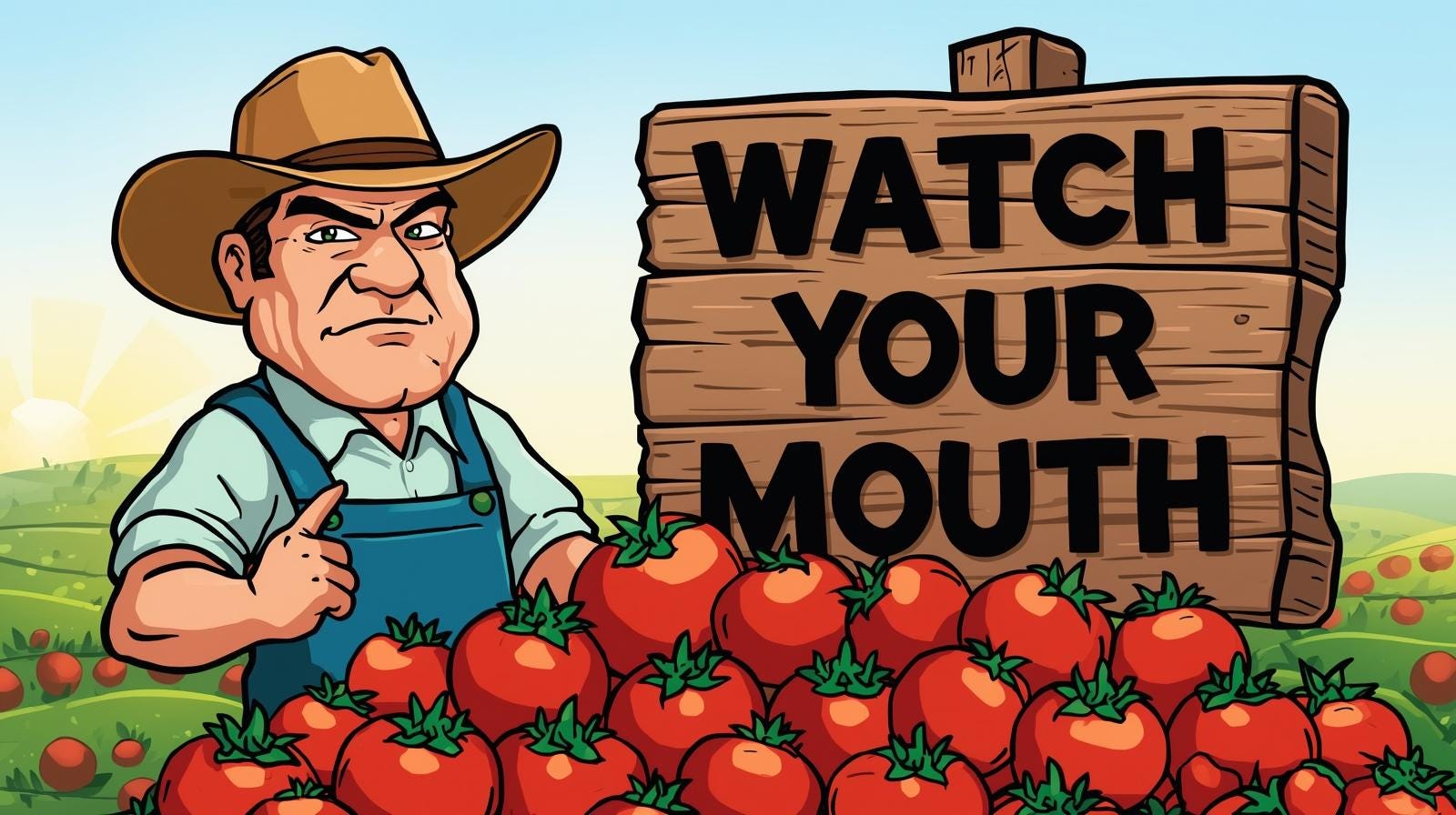
Florida Legislature may expand its Veggie Libel Law--you say tomato, I say, see you in court
If you thought Florida was weird, it gets even stranger in Tallahassee this time of year
It may be the Free State of Florida, but if some lawmakers have their way, you will no longer be free to say unkind things about vegetables.
Or, for that matter, fruit or sugar cane, or the pesticides, antibiotics, burning or other methods used by Big Agriculture.
If you do, you could be sued.
So much for free speech.
Welcome to the Veggie Libel Bill, which is making its way through the State Legislature.
And, yes, it is exactly what it sounds like. You could be dragged into court for defamation if you say unkind things about, for instance, tomatoes.
In fact, there’s already a law on the books that makes it actionable to defame perishable produce in Florida, believe it or not.
Now, revisions to that bill would extend it to all agricultural products, not just perishables, and to the methods that are used by the various farming industries to harvest those crops.
So, for example, if you think it’s a bad thing that sugar cane growers pollute the Everglades, you could be sued if you said so.
Or, as a headline from Captains for Clean Water proclaimed:
A Florida bill could bankrupt you for speaking up about pollution
There’s a provision buried inside a bill moving quickly through Tallahassee that could financially punish citizens, nonprofits, and journalists for speaking out about agricultural practices that impact Florida’s waterways.
It’s moving through the Florida Legislature as a part of a larger package, SB 290/HB 433, being referred to as “The Florida Farm Bill.”
And one section in particular could become a powerful tool to silence public criticism of agricultural interests like Big Sugar in Florida, even when the criticism is about practices that harm our water.
I looked the bill up, and while much of it simply strikes the word “perishable” from agricultural products (meaning the law would now apply to all agricultural products), here’s the section that is drawing the most criticism:
The revised bill would make it actionable to defame any and all methods used by the agricultural industry as well as the actual crops. It “includes any agricultural practices used in the production of such products.”
As the Miami Herald noted in an opinion piece:
A provision tucked into a 60-plus-page bill dealing with farming issues would make it easier for agricultural interests to sue for defamation. The legislation doesn’t specifically mention sugar farmers but appears geared toward chilling criticism that is most often directed toward them. If approved, the proposal will send a message to environmental groups that are often at odds with the industry — and to the journalists covering these issues — that costly litigation could be the price for speaking up.
The danger in the current environment is that these laws can be weaponized,” Bobby Block, executive director of the First Amendment Foundation, told the Herald Editorial Board.
The current law allows agricultural interests to sue you if you say something about, say, strawberries, that is “not based on reliable, scientific facts and reliable, scientific data which the disseminator knows or should have known to be false.”
This revision would go beyond that to how things are grown and the consequences of those practices.
So, for instance, if you are concerned about, say, the long-term consequences of using antibiotics to combat citrus greening or you have worries about weed killers and their alleged link to certain kinds of cancers, would speaking out about that—even if you were just raising questions—be considered defamatory?
As the Herald further noted:
Under SB 290, and its House companion, HB 433, Florida’s food libel laws would now also cover nonperishable agricultural goods — including sugar. Critically, the bill would also allow the industry to sue over disparaging statements about “any agricultural practices used in the production of such products.” That appears to target sugarcane burning in the Glades region, a harvesting practice residents and activists have fought for years because of its health impacts on nearby communities.
Yesterday, as Friends of the Everglades noted on Facebook, the legislation hit a stumbling block:
Senate Bill 290 has been temporarily postponed, but the threat is still very real. This bill would expand Florida’s food libel law, allowing Big Sugar to sue critics for speaking out about products like sugar and practices like sugarcane burning.
Silencing public health and environmental voices is not protection, it’s intimidation.
The bill will be heard again at a future Rules Committee meeting. That means now is the moment to speak up.
What can you do?
Friends of the Everglades is suggesting that people call or email members of the Senate Rules Committee and urge them to vote NO on the bill.
The Rules Committee is chaired by Sen. Kathleen Passidomo of Naples. The vice chair is Sen. Shevrin Jones of Miami-Dade County.
Here’s a link to all committee members, which includes their district office locations and phone numbers:
Really, this is kind of embarrassing that our state is even considering this.
Bad enough that we were a national laughingstock for our Don’t Say Gay legislation. Now, what? Don’t say tomato?
Related:
A Florida bill could bankrupt you for speaking up about pollution
Florida lawmakers are about to hand a revenge tool to a much-criticized industry
Friends of the Everglades on Facebook
J.C. Bruce is the founder of Tropic Press, a Florida online news service dedicated to sharing news and commentary relevant to Florida readers, whether it originates in the Sunshine State or elsewhere. Bruce is an award-winning former newspaper editor, journalist and author living in Florida, his native state.
Onward thru the fog
It’s easy to feel overwhelmed if you are a rational person living in the Free State of Florida, but there are plenty of smart, reasonable people just like you here. The purpose of this newsletter and the Tropic Press website is to provide a source of news and commentary that shines a light through this irrational fog.
Thank you for your support as a subscriber. It is invaluable. This is especially so for those of you who have chosen to upgrade to paid subscriptions. Your contributions are making this possible.
J.C. Bruce
Sharing is caring
As this newsletter was written, Tropic Press was reaching more than 750,000 subscribers in Florida and elsewhere. With mid-term elections on the horizon, the more people we reach, the more effective we can be in helping turn this country around. You can play a vital role in that effort by sharing this newsletter with friends. If you are reading this as an email, simply forward it. Or you can use the link below. Thanks.
Today’s sponsor
Today’s report is brought to you by Tropic Press Books, home of The Strange Files. The six-book series makes the perfect New Year’s present for the mystery fans in your life. You can find more information about these hilarious stories here.


So much for free speech? Say what you want but not about issues involving vegetables…hilarious…people with no brains have too much power.
If enacted, this law would appear to be in direct violation of the First Amendment and thus unlikely to stand.