
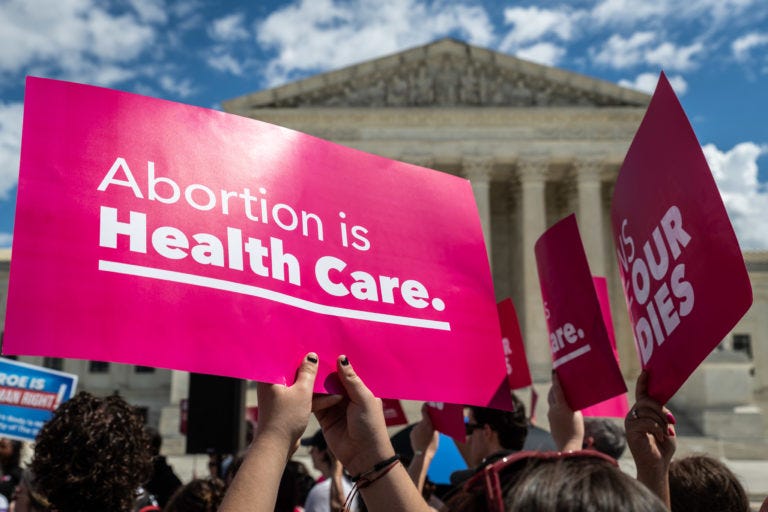
Reproductive 'freedom' bills would revive access to abortion care in Florida
Bills would strike a 2023 law that allows health care providers and payors to deny medical care based on conscience.
Today’s report is from Florida Phoenix reporter Christine Sexton, which Tropic Press is proud to share.
By Christine Sexton
A pair of Florida Democrats has filed legislation that would, in effect, eliminate the state’s restrictive six-week abortion ban and other laws limiting abortion access and guarantee access to reproductive health care.
Called the Reproductive Freedom Act, the bills were filed on the 53rd anniversary of the landmark Roe v. Wade, the 1973 U.S. Supreme Court decision that made abortion legal in the United States. It was undone by the 2022 Dobbs v. Jackson Women’s Health Organization decision that returned abortion regulation to the states.
“The Reproductive Freedom Act would ensure all Floridians can access the full range of reproductive health care options, without the government looking over their shoulders in the exam room,” House Democratic Leader and HB 1151 sponsor Fentrice Driskell said.
“I can’t think of a better time to announce this than the anniversary of Roe v. Wade. It was a decision that protected our grandmothers, mothers, and daughters until extremist judges and politicians took it away.”
A 2024 attempt to enshrine abortion rights in the Florida Constitution was supported by 57% of voters but failed to meet the 60% mark needed to pass.
Pro-abortion right legislators are quick to remind Republican leadership that while the 2024 amendment failed, it was supported by a majority of voters. Still, the proposals are unlikely to pass the Legislature at a time when the GOP supermajority seems intent on expanding restrictions on reproductive freedom — allowing would-be parents to file wrongful death suits for embryos, for example, and requiring public school children to watch “fetal development” videos as part of the academic curriculum.
Jacksonville Democrat Sen. Tracie Davis has filed identical legislation (SB 1308) in the Senate.
“You’ve heard us say this a thousand times before. And we’re going to keep saying it until we can change the law: All Floridians must have the freedom to make their own choices about their health care, in consultation with doctors who’ve taken an oath to act in their patients’ best interests,” Davis said.
“At no time is a politician more qualified than individual patients and doctors trying to navigate unique, and sometimes life-threatening, health care decisions. We’re already facing a shortage of OBGYNs in this state and if we don’t pass the Reproductive Freedom Act, it’s only going to get worse.”
The bills wouldn’t alter or change any of the state’s existing abortion statutes. Instead, they would modify the state’s general public health laws, inserting legislative intent language into statute to make clear that the principles of individual liberty, personal privacy, and equality that are protected in the state Constitution ensure access to reproductive care.
The right to reproductive health care includes, but is not limited to:
A fundamental right to make autonomous decisions about the individual’s own reproductive health, including the right to use or refuse reproductive healthcare; and
A fundamental right to choose whether to continue the pregnancy and give birth or to obtain an abortion and to make autonomous decisions about how to exercise this fundamental right.
The bills would also amend public health statutes to make clear that “a fertilized egg, embryo, or fetus does not have independent rights” in Florida.
The bills would amend statutes to ban the state, county, or local governments from denying or interfering with an individual’s fundamental right to access reproductive health care. The bills also would ban any state or local law enforcement agencies or officials from harassing or discriminating against an individual for providing or obtaining reproductive health care or for assisting another person in doing so.
A 2023 law that prevents the use of state funds to foster travel to another state for abortion care and another law that bans a health care surrogate or proxy from consenting to an abortion on another person’s behalf also would be eliminated by the bills.

Boca Raton reproductive endocrinologist and fertility specialist Dr. Leah Roberts said that in many ways reproductive care is treated differently by lawmakers than other health care, with state legislatures more willing to intervene in its delivery.
“You know, there seems to be this carve out. You know, nobody’s gonna tell a cardiologist that they can’t, you know, put a stent in someone, but it seems to be looked at very differently when it comes to OBGYN care,” she said.
“I don’t think it’s a fair thing to be happening. I mean, I went to undergrad for four years, med school for four years, four years of residency. I practiced for a year and then did three more years of fellowship. So, certainly, I have just as much training if not probably a year or two more, than any cardiologist in regards to my organ system, which just happens to be, you know, only in women,” she said. “But it also affects men.”
ACLU of Florida Executive Director Bacardi Jackson said the bill would give every Floridian freedom over health care decisions.
“Decisions about whether and when to use birth control, whether to continue or end a pregnancy, and whether and when to grow a family are among the most personal decisions anyone will ever make. These choices shape our lives, our health, and our futures. Politicians are never more qualified than individuals, families, and their doctors to make these deeply personal decisions, and Florida’s laws must reflect that truth.”
The focus of the five-page bills is access to reproductive care, but the legislation also would strike a 2023 statute that allows health care providers and payors to deny medical care based on conscience.
The reporter on this story, Christine Sexton, has spent more than 30 years writing about Florida health care, insurance policy, and state politics, and has covered the state’s last six governors.
Florida Phoenix is part of States Newsroom, the nation’s largest state-focused nonprofit news organization.
You can support the work of Florida Phoenix here:
Note to Readers:
One of the missions of Tropic Press, in addition to creating original reporting and commentary, is to share great journalism from independent reporters and news organizations from around the state, hence today’s post from Florida Phoenix, which is reprinted here with their permission
You can help Tropic Press with this mission by subscribing. Thank you.
About that abortion ballot initiative that failed…
In 2024, Florida voters went to the polls to, among other things, vote on two ballot initiatives that would restore women’s reproductive rights, as was mentioned in the above story, and to legalize recreational marijuana.
Both ballot measures were approved by a strong majority of voters but narrowly failed to hit the 60 percent mark as required by state law.
One of the reasons that 60 percent threshold was not reached can be traced back to the tens of millions of dollars misused by Gov. Ron DeSantis when he directed state funds to campaigns opposing these measures.
Said another way, the vote was unfairly—and perhaps illegally—influenced by DeSantis rerouting taxpayer dollars that were supposed to be used for other purposes.
It is not unreasonable to speculate that were it not for DeSantis’ questionable actions, both of these measures might have passed.
Said State Sen. Joe Gruters, a Sarasota Republican and chair of the Republican National Committee, at the time:
“No matter where you stand on an issue, this is still a democracy, and in a democracy, we do not spend taxpayer dollars in advance of a political issue. Tax dollars are meant to be spent on our police, schools, roads and other public programs that make our state great, not for political agendas.”
Onward thru the fog
It’s easy to feel overwhelmed if you are a rational person living in the Free State of Florida, but there are plenty of smart, reasonable people just like you here. The purpose of this newsletter and the Tropic Press website is to provide a source of news and commentary that shines a light through this irrational fog.
Thank you for your support as a subscriber. It is invaluable. This is especially so for those of you who have chosen to upgrade to paid subscriptions. Your contributions are making this possible.
There’s no doubt the coming months here in Florida and nationally will be trying. But I firmly believe brighter days are ahead. Chin up, keep a smile on your face, and stay sane.
J.C. Bruce
Sharing is caring
As this newsletter was written, Tropic Press was reaching more than 750,000 subscribers in Florida and elsewhere. With mid-term elections on the horizon, the more people we reach, the more effective we can be in helping turn this country around. You can play a vital role in that effort by sharing this newsletter with friends. If you are reading this as an email, simply forward it. Or you can use the link below. Thanks.
Today’s sponsor
Today’s report is brought to you by Tropic Press Books, home of The Strange Files. The six-book series makes the perfect New Year’s present for the mystery fans in your life. You can find more information about these hilarious stories here.


It’s all well and good that FL State Senator Joe Gruter suddenly opposed his Gov., DeSantis, for diverting taxpayer money toward a political cause in 2024 to defeat the abortion and marijuana bills.
I’d like to know how he voted on the many extreme right, anti health care bills, like allowing any citizen to sue a medical professional who helps a woman in medical distress and in need of life/saving procedures due to any pregnancy related emergency.
Put your wife or teen daughter on that ER exam table, Sir, and declare that she should die rather than get care for a miscarriage that became life- threatening.
Hypocrisy doesn’t belong on the medical profession any more than in the political theater.
Really appreciate how the piece frames the 2023 conscience clause in the broader context. Letting providers opt out of care based on personal belifes creates a two-tier system where access depends on geography and luck, not need. I saw this play out with a friend in a small town who had to drive 3 hours for basic reproductive care after a miscarige.